If you are looking for a single piece that can bear group honor, personal ID, and cultural narratives, then baseball jackets come to mind in seconds. The history of baseball jackets can be dated back to 1865, the Harvard University baseball team sewed the school’s initial – the letter “H” – onto their knitted uniforms as a reward mechanism to distinguish outstanding players: only those who participated in the year’s major games were permitted to keep it, while the others were required to return it. That giant, large chenille applique is not the proof of belonging, but also the right that needs very hard work to earn it. 10 Years later, this mechanism was expanded to football teams, and was gradually popular to universities and then down to middle and high school grades. Until the 1930s, leather sleeve patchwork woolen baseball jackets replaced knitted baseball jackets, and the modern baseball jacket was formally formed. In 1950, baseball jackets became the fashion trend among young groups, becoming the outer icon of street attitudes. Elvis Presley, James Dean, and Michael Jackson once wore baseball jackets, putting baseball jackets from sportswear to the forefront of pop culture.
In recent years, Louis Vuitton, Stüssy, and Kapital have continuously reinterpreted these classic baseball jackets, making them continue to escalate in young groups. Baseball jackets are never out of the fashion field, they just have changed their places from school elites to honorable medal, becoming an iconic mark for subculture. Ultimately crystallizing into an enduring visual anchor within popular culture.
The Baseball Cap Revolution from Varsity Headwear
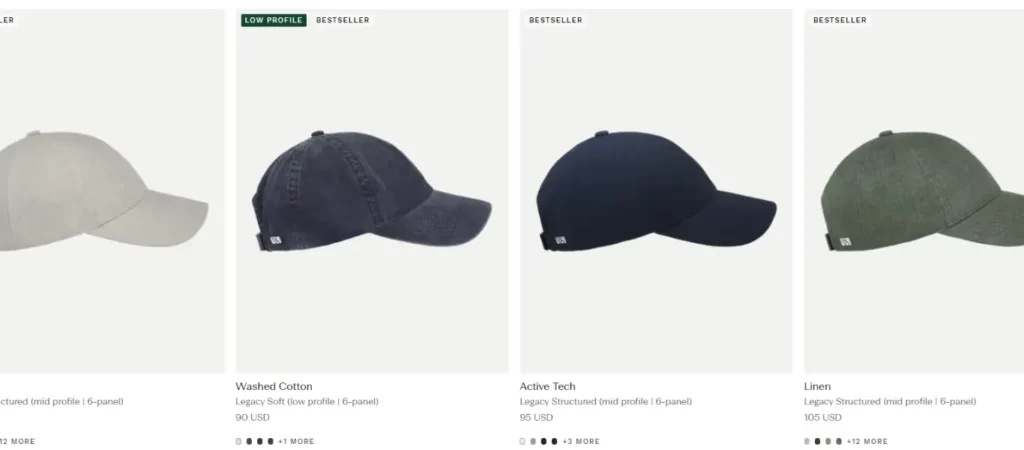
However, when baseball jackets have been redefined across different eras, baseball caps have experienced the same. In the headwear field, Varsity Headwear gives an almost diametrically opposite answer – while most people layer up the icons, Varsity Headwear, a hat brand from Oslo, Norway, does subtraction on baseball caps.
Created by two brothers, Alexander and Sebastian Adams, in 2013, they have had a deep passion for baseball caps since they were kids. However, they cannot find a truly satisfying baseball cap, whether the logo is too uproarious or the silhouette is not cozy enough, or even the fabric cannot stand the test of time. So they decided to make baseball caps themselves. In a small space beneath their parents’ construction firm office in Oslo’s Majorstuen district, they produced their first batch of twill wool hats, selling them to friends and family. This was the start of everything.
From the beginning, theory is extremely clear that creating a perfect baseball cap does not rely on its logo, but rather on the silhouette, fabrics, and wearing experience. In other words, their baseball caps don’t rely on calling out, but on precision in silence, which is an extremely brave choice for positioning. Most fashion brands occupy consumers’ attention by updating logos and visual impacts at high frequency. Choosing subtracting logos means to abandon the most directive brand patch and turn to the persuasiveness of the products themselves. This type of strategy needs a brand to achieve its maximum in invisible details – every adjustment in the silhouette, the choice of each fabric, and the wearing experience, all must be beyond reproach.
What Has Varsity Headwear Done?
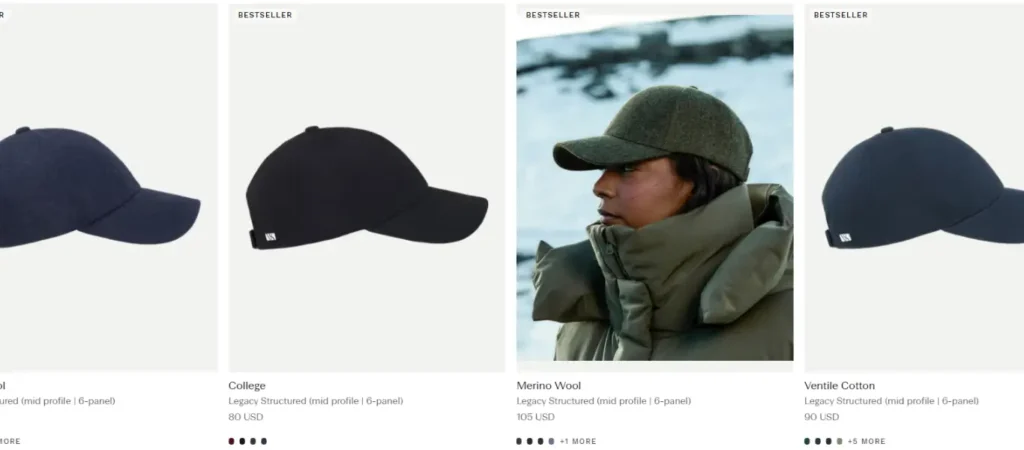
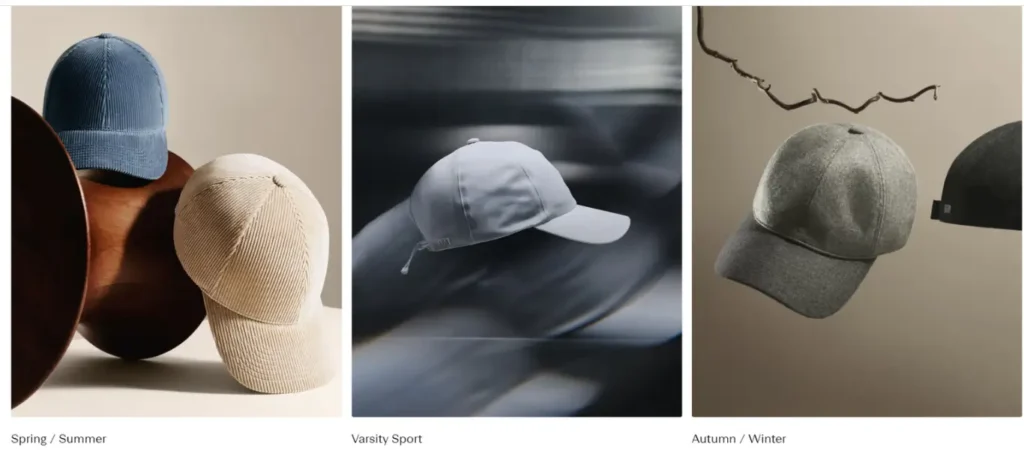
By 2024, Varsity Headwear has been around for more than a decade, yet it still does just one thing – baseball caps. This almost obsessive focus is nearly a rarity in today’s fashion industry. Its core silhouette is a 6-panel Legacy to better cater to different head shapes. Here are two types: soft 6-panel Legacy and structured 6-panel Legacy. To address the winter and summer conditions and functional scenarios separately, summer baseball caps are made from linen, and winter baseball caps are made from Merino wool and waterproof canvas. Later, it also introduced a high-tech functional fabric series, Athletic Sport and Active Tech, from the Swiss company Schoeller AG. These fabric components come from different countries: cashmere from Inner Mongolia, China; merino wool from Australia; and linen and cotton from textile companies in Italy.
Varsity Headwear is not the kind of brand that treats “limited edition” as its marketing gimmick – it genuinely, year after year, through iteration, pushes each baseball cap to a higher balance of function and aesthetics. In 2019, it even launched its first cashmere blended beanies, and it still maintains its characteristic restraint and prudence from fabric research and development to pattern refinement. Developing one hat in 10 years is not old-school, conservative, and it’s the choice that it chooses deeply. Varsity Headwear refuses to use rich SKU to cover the wide hat wear market; instead, it pierces the thickness of time with an uncompromising single piece.
What’s Varsity Headwear?
If we just regard Varsity Headwear as a high-end baseball cap brand, we underestimate its cultural ambition. Its story is not born in New York or Tokyo, and it’s from Oslo, Norway, a city that has no relationship with the origin of baseball caps, which is a very funny narrative story. Baseball caps were born in American Sports Leagues in the mid 19th century, and early designs can be traced back to the dome long-brim hat style used by the Brooklyn Excelsiors team in 1860. Until the early 20th century, various sports teams started to add their team logos and mascots, and baseball caps had gradually shifted from sports gear to a symbol of team spirit. In 1940, 6-panel patchwork, stiff, curved-brimmed baseball caps became mainstream, and baseball caps also left the ballpark from this point onward, becoming the everyday wear standard of street garments.
At its essence, baseball caps are an item from American culture that carries the competitive spirit, the school honor mechanism, and the rebellious spirit that was absorbed by hip-hop culture later. However, Varsity Headwear, starting from Northern Europe, strips baseball caps out of their original cultural context and reintroduces them with a Scandinavian design philosophy: restraint, simplicity, and function first. Its color tones come from natural scenery in Norway – earth color, deep green, grayish blue, and no exaggerated fluorescent colors, without large-scale printed patterns. Varsity Headwear makes baseball caps back to an essential state – it’s not about declaring anything, but about fitting the head, adapting to the climate, and standing the test of time. This cultural displacement itself constitutes a contemporary interpretation that baseball caps are not the sub-accessories of the American school culture and street trends, and baseball caps can be a cozy and quiet lifestyle. This brings to mind LV’s reinterpretation of Ivy League style in its 2026 fall/winter men’s capsule collection – Pharrell Williams blends the academic sensibility of Ivy League campuses with traditional British tailoring, where varsity sport and luxury fashion meet through refined craftsmanship. Different brands are rewriting the cultural grammar of varsity in their own way, and Varsity Headwear has chosen the most restrained version.
The Professional Custom Hat Manufacturer – Aung Crown
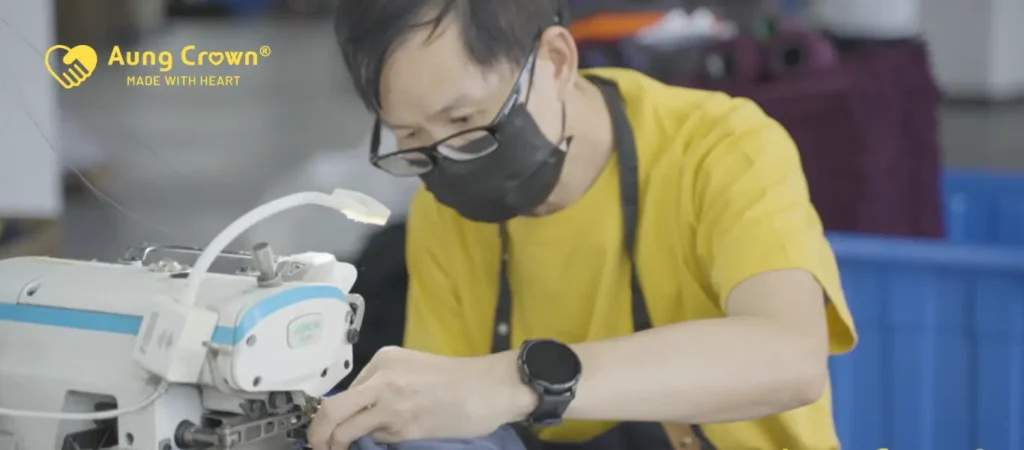
Meanwhile, the other parallel narrative line is worth focusing on – during the globalization of manufacturing, the manufacturing power of China, represented by Aung Crown, is quietly and firmly supporting innovation and expansion in the global headwear industry. Founded in 1998, Aung Crown started in Shenzhen, Guangdong province, and now it’s a leading custom hats and apparel manufacturer worldwide, cooperating with more than 30,000 brands. With a 24,000 square meter factory, owning 400+ experienced staff, and its monthly production can reach over 400,000 pieces of hats. When Varsity Headwear’s designers repeatedly fine-tune the curvature of a cap design in their studio in Oslo, what ultimately turns these designs into high-quality, scalable products is the manufacturing system behind it – built on decades of craftsmanship. Aung Crown offers a whole custom service that includes the entire production chain, from raw material procurement, cutting, and sewing, to embroidery, quality inspection, and final packaging. What’s more, Aung Crown not only provides design support, custom tags, and packaging services, but also can use its insight into international trends to help brands complete the whole process from concept to execution.
Varsity Headwear NATO watch straps are inspired from 100% nylon adjustable straps, and the original place is China. This seemingly unassuming NATO watch strap actually embodies the intricate collaboration of globalization: design inspiration from Norway, precision manufacturing in China, and a global network of fabric suppliers – all converging to create a baseball cap capable of accompanying its wearer for years. In the realm of sustainable manufacturing, Aung Crown is simultaneously advancing eco-friendly practices, including the use of recycled yarns and the implementation of fair labor standards. It serves as a testament to one fundamental truth: high-end manufacturing signifies not merely production capacity and efficiency, but – more importantly – a profound respect for every process, every material, and every worker involved.
Varsity Headwear’s approach to community engagement is equally worthy of reflection. Far from being an aloof luxury brand, it regularly organizes community events – inviting select customers to participate in celebrations – thereby transforming wearers from mere consumers into co-creators of the brand’s narrative. By opening flagship stores in locations such as Saint-Tropez, Cannes, Dubai, and Kuwait, and launching a pop-up shop in New York’s SoHo district, the brand has established a discreet yet tightly knit global network. Its consumers include Casper Ruud, a Tennis player, mountaineers from Kyrgyzstan, as well as regulars of the ski season at Aspen, the resort town in Colorado, USA. All of these people don’t know each other, but they share a lifestyle – pursuing the experience that transcends material abundance, and yearning to discover a genuine sense of existence through travel and sports. This is a sense of belonging that requires no loud proclamation, quietly forged through the simple link of a baseball cap.
In the Future
In the future, Varsity Headwear will undergo a new wave of global dissemination. In the 2026 men’s casual trends, Y2K vintage remains strong, and Varsity jackets, retro sneakers, and loose denim trousers are important pieces for the Z-Generation closet. The boundary between the collegiate style and luxury fashion is dissolving, a convergence that further amplifies the cultural resonance of Varsity Headwear iconography. As one of the most instantly recognizable items within this cultural lineage, baseball caps will undoubtedly continue to benefit from this trend.
However, Varsity Headwear chooses a different way. It does not chase the ebb and flow of fashion trends; rather, it aspires to be the singular piece that is worn long after the trends have faded. Varsity Headwear doesn’t care about next season’s trends; it cares that its baseball caps can still be cozy, fit snugly, and people still wanna wear them after 3, 5, or 10 years. This anti-trend attitude is properly loyal return to the Varsity Headwear spirit. Because the intent of Varsity Headwear is never about trends – it’s an honor, belonging, and a time filter.
Back to the initial question – why baseball caps can across board, classes, and time, becoming an enduring cultural icon? Varsity Headwear gives its answer – because the best icon is often not the loudest one, but the one that fits best. Varsity Headwear does not rely on logo, not defined by trends, its baseball caps can be worn quietly on the head, which can accompany people around 4 seasons, from urban cities to mountains. What Aung Crown represents is this accompaniment that its solid base is composed of exquisite craftsmanship, sustainable theory, and insistence on quality, turning designs into real products, and making theory into real items. For this point, although Varsity Headwear and Aung Crown are positioned at the opposite ends of the value chain, they share a common belief – true value is not something to be seen, but something to be felt.
While a baseball cap doesn’t need to prove anything, it can be just itself.
FAQs
FAQ 1: Why Does Varsity Headwear Insist on “De-logo” Design? Is That Too Ricky in a Trend-Driven Market Where Logo Worship Runs Rampant?
Answer: Quite the opposite. The de-logo strategy of Varsity Headwear is not a marketing gimmick, and it’s a choice of philosophical design. Its founders, Alexander and Sebastian Adams, brothers, found that baseball caps on the market are occupied by large brand logos or the silhouettes and fabrics are hard to satisfy. They wanted to make a hat that didn’t need to prove itself via large logos, but by its cozy wearing experience, a snug fit, and fabrics’ performance in all seasons. This type of strategy seems to abandon the most distinctive brandy way, but it brings the competition back to products themselves.
In today’s landscape – marked by the streetwearization of luxury goods and an inflation of logos – a quiet, understated baseball cap has, ironically, become a rarity. Varsity Headwear baseball caps are not designed to be “seen,” but rather exist to be “felt.” As it turns out, this counterintuitive approach precisely resonates with the needs of mature consumers who prioritize intrinsic quality and have grown weary of the bombardment of brand iconography.
FAQ 2:Varsity Headwear from Norway, Yet Baseball Caps are from America. How Does A Nordic Brand Interpret and Reimagine an Item so Deeply Imbued with a Strong Sense of Regional Identity?
Answers: This is the funniest cultural displacement. Baseball caps were born in the American Sports Leagues in the mid 19th century. Over time, layered with the traditions of collegiate honors, hip-hop culture, and street trends, it evolved into one of the visual icons of the American spirit. However, when transplanted to Norway – a nation renowned for its austere natural landscapes, minimalist design, and functionalism – its original cultural baggage was stripped away. Varsity Headwear retained the baseball cap’s most essential structural elements (a 6-panel construction, curved brim, and adjustable back strap) but distilled its color palette down to earthy shades of gray, green, and blue; upgraded its materials to Merino wool, linen, and high-tech performance fabrics; and shifted its aesthetic language from “declaring identity” to “blending with the environment.” It no longer signifies the honors of an American high school football team, but rather represents a morning hike in Oslo, a ski run in the Alps, or an afternoon coffee by the Mediterranean. This reinvention is not a repudiation of the original culture, but rather an act of liberating it from specific spatial and temporal coordinates, transforming it into a universal, understated language of everyday life.
Having studied in the U.S., I now lead the global digital operations at Aung Crown. My passion lies in blending fashion trends and musical inspiration into the B2B landscape, allowing me to share the unique craftsmanship of Chinese hat-making with a global audience.