Aung Crown’s Insights to Cross-style Fusion Trends for Spring 2027
Curated and written by Aung Crown Team.
Throughout the fashion industry’s evolution, style labels were once the most convenient language between designers and consumers. However, when British countryside style, Scandinavian minimalism, and vintage style are overused, they become creative constraints instead of inspirations. Copenhagen Fashion Week Spring/Summer 2027, which ran from August 3 to August 7, 2026, shows us a deeper creative path – not to copy the outer symbols of styles; instead, distill the essence of the original aesthetic and reinterpret it via a different, fully developed design language.
As an OEM/ODM custom hats and apparel manufacturer, we, Aung Crown, believe that the cross-style reinterpretation between British countryside style and Nordic Scandinavian minimalism is not only a simple breakthrough of the aesthetic layer, but also a powerful demonstration of modern women’s design methods.
Over Symbols – The Deep Logic of Style Fusion
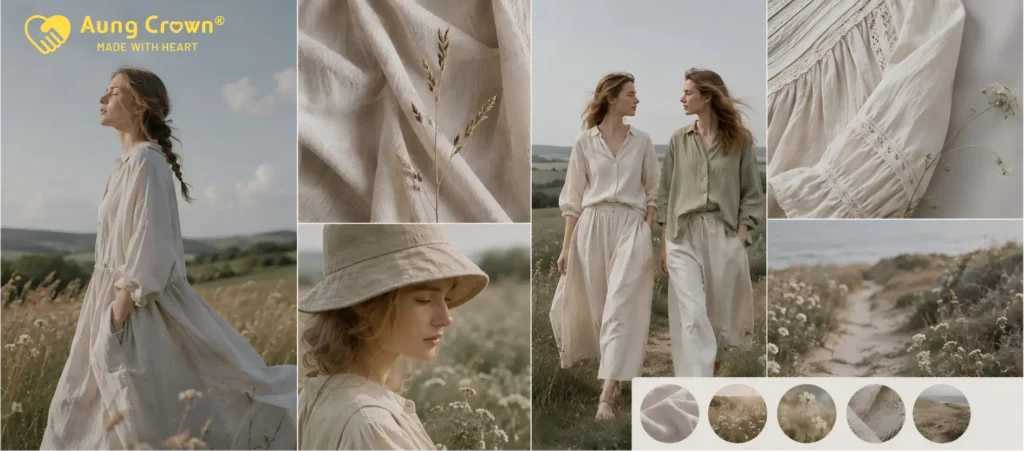
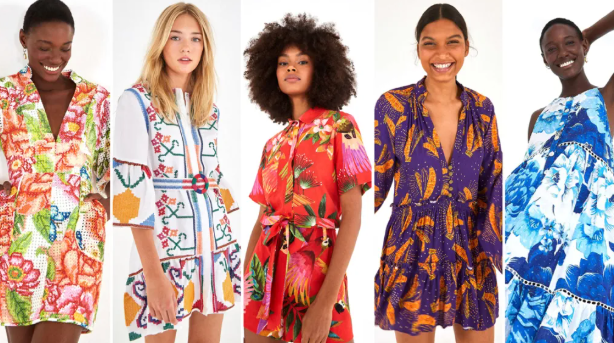
Traditional British countryside style relies on a dense layering of visual signatures – floral prints, lace, and ruffles. These elements are not inherently good or bad. However, when overused, they can easily tip into a saccharine, surface‑level aesthetic. What sets the Spring 2027 collection apart is that designer Jane Aus draws inspiration not from a pattern, but from a state of being – the sense of ease that washes over both body and mind when immersed in the countryside.
This is a shift from visual symbol to atmospheric perception. Loose, full-skirted dresses and leisured separates allow clothing to move beyond constraining the body and instead become an extension of how we breathe and move freely in nature. Countryside atmosphere won’t need floral prints to prove itself anymore, but will show itself via silhouettes and texture. The takeaway for designers is this: a style’s true distinctiveness comes from how accurately its underlying spirit can be translated – not from the sheer number of decorative elements it contains.
Nordic Frame: Restraint Is Not Scarcity – It’s Precision
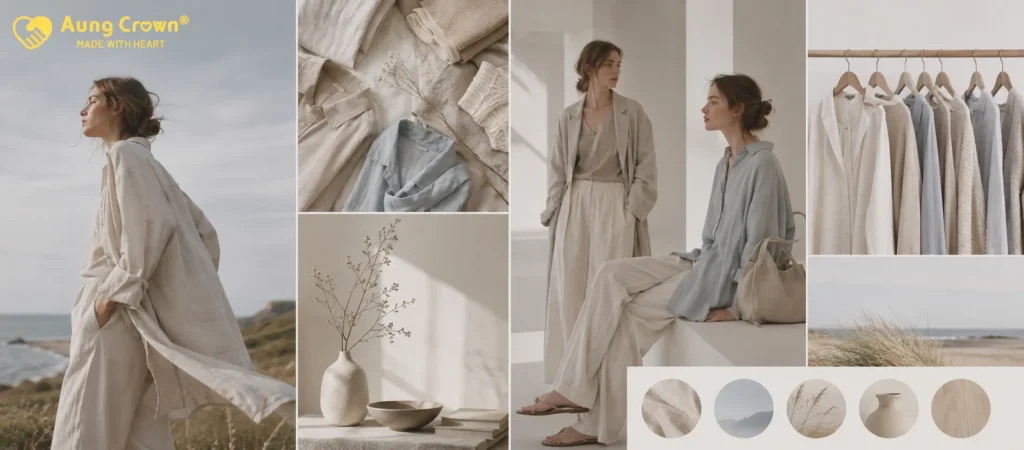
The British countryside style sets the base; Scandinavian minimalism gives it structure. Nordic design isn’t about cutting back – it’s about getting it right. Every line, color, and fabric must balance function and feeling with exacting precision.
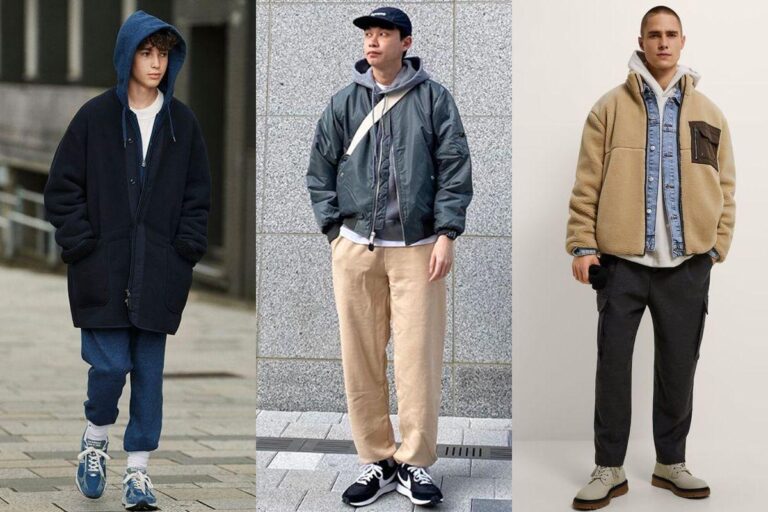
In this collection, loose and free silhouettes replace the close-fitting curved tailoring. In this collection, loose and free silhouettes replace the close-fitting curved tailoring. Low-saturation beige apricot, misty blue, and warm naked colors replace striking high-saturation colors. The changes in fabric textures become the core source of visual focus. Such an effortless design attitude actually needs super high control of aesthetics. Because after a huge decreasing of ornaments, any imbalance in proportions or error in color coordination will be magnified infinitely.
Therefore, we, Aung Crown, particularly agree with the design baseline of no leather and no fur in this collection, which is not only a response to animal cruelty in fashion but also a long-term attitude for fashion. The value of a piece of clothing should not rely on the sense of luxury materials, but be based on the lasting design and cozy-wearing experience.
Fabric Language: Narrative Ability of Natural Fabrics
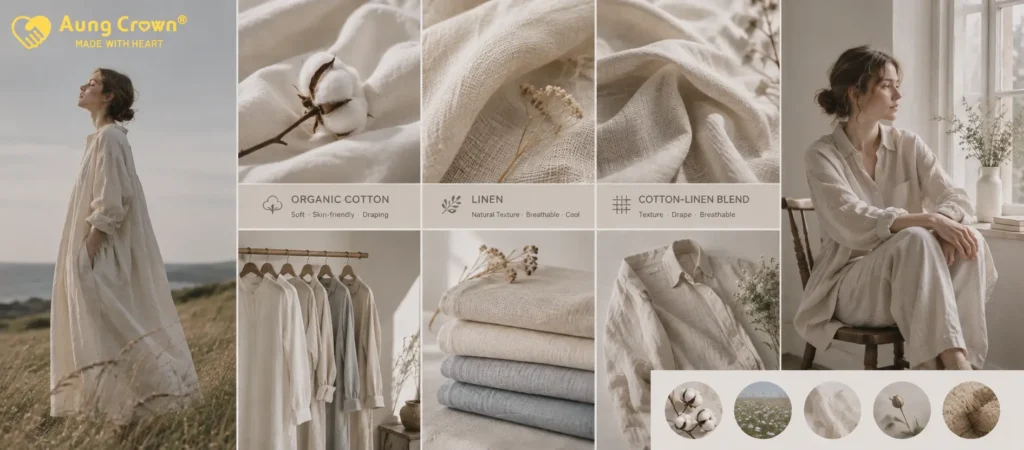
This collection adopts lots of organic cotton, linen, and cotton-linen blends, which are the fabric base for establishing this design theory. Natural fabrics are the perfect carrier of a sense of ease, which is not an accident.
Organic Cotton: Soft, skin-friendly, and draping, organic cotton is suitable for making shirts, suits, and long dresses. Its advantages are that it can bring a close fit to our body and won’t produce the sensation of fabrics fighting against people.
Linen: The most unique visual asset is its natural texture. The clear fiber texture of linen gives clothing an original beauty, which is raw and unpolished. What’s more, the excellent heat dissipation and great breathability make linen an ideal choice in spring and summer. With every wash, it becomes softer to the touch, developing a character that only gets better with wear.
Cotton-linen Blend: This blend can keep linen’s raw texture and improve the easy-to-shirk problem, combining draping and breathability at the same time, which becomes the most popular one in this collection. The strategic essence of this type of fabric blend is to use fabric natural textures to replace pattern printing.
During our practices in hat and apparel making, we, Aung Crown, have noticed that natural fabrics have shifted from niche aesthetics to the mainstream market based on our order data in recent years. The problem of discomfort from wearing chemical fabric, consumers face, and now they are starting to pursue natural fabrics that can offer a cozy wearing experience. Such a shift is not only driven by conscious awareness, but also the result of seeking a better wearing experience.
Industry Resonance from Runways to Fabric Market
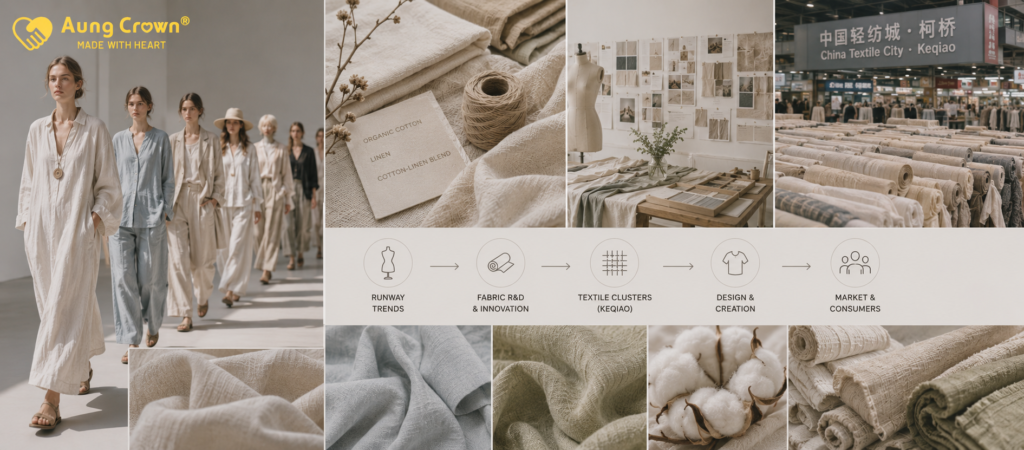
This is a two-way exchange between runway trends and fabric markets. What deserves attention is that this trend is far from a mere “castle in the air” confined to the runway. Organic cotton, linen, and cotton‑linen blends have already become hot categories in the development of “relaxed‑fit” womenswear in China. Textile industry clusters like Keqiao are forming a virtuous cycle: international trends guide fabric R&D, and fabric innovation, in turn, feeds back into design and creation.
This presents a critical window of opportunity for Chinese designer brands. As the supply side offers greater variety and more mature processing techniques for natural‑fiber fabrics, designers are no longer constrained by the difficulty of sourcing materials when creating fusion‑style collections. At the same time, local fabric suppliers should keep a close eye on the material signals from international runways, transforming trend insights into scalable, customizable fabric solutions.
Our Insights and Future Prospects
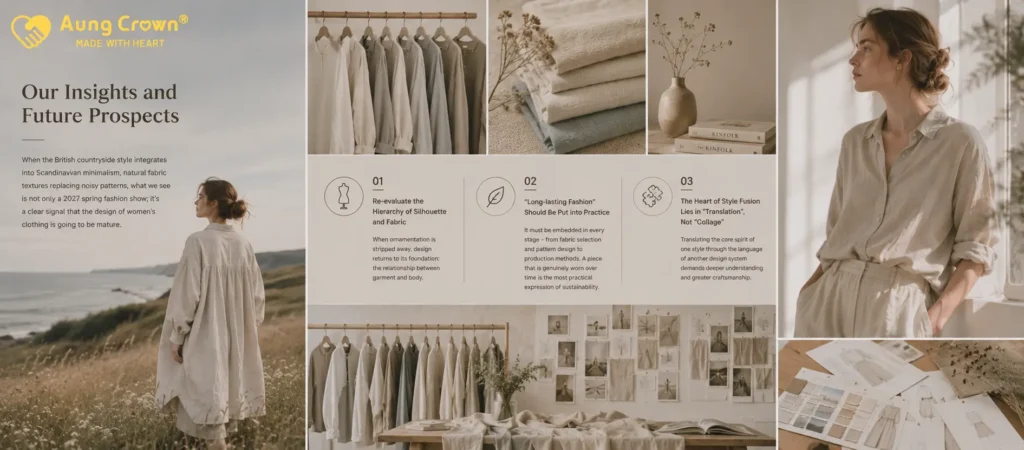
The true value of this fashion show is not that it creates a style that cannot be copied; instead, it demonstrates a design mind without standardized labels. The ways of fashion expression are turning from adding elements to building the sense of atmosphere, from visually striking to a wearing experience first. For brands, what does this mean for them?
- First, the hierarchy of silhouette and fabric needs to be re-evaluated. When ornamentation is stripped away, design returns to its foundation: the relationship between garment and body.
- Second, “long‑lasting fashion” should not remain a marketing catchphrase. It must be embedded in every stage – from fabric selection and pattern design to production methods. A piece that is genuinely worn over time is the most practical expression of sustainability.
- Third, the heart of style fusion lies in “translation,” not “collage.” Translating the core spirit of one style through the language of another design system demands deeper understanding and greater craftsmanship than simply layering elements from two styles together.
We always believe that the real style doesn’t rely on what you wear, but whether clothing can make you feel better and freer or not. When the British countryside style integrates into Scandinavian minimalism, natural fabric textures replacing noisy patterns, what we see is not only a 2027 spring fashion show; it’s a clear signal that the design of women’s clothing is going to be mature.
FAQs About British Countryside Style and Nordic Scandinavian Minimalism
Having studied in the U.S., I now lead the global digital operations at Aung Crown. My passion lies in blending fashion trends and musical inspiration into the B2B landscape, allowing me to share the unique craftsmanship of Chinese hat-making with a global audience.