Yarn count
Yarn count refers to the fineness of the yarn. The main indicators used to express yarn fineness include S, D, N, Tex, and Dtex. Specific fabrics use specific specifications, with S and D being the most commonly used. However, scientific and technical literature generally uses the tex equivalent.
Commonly Used Indicators
1. Metric count (Nm) (fixed weight system)
Metric yarn count refers to the length in meters of 1 gram of fiber or yarn at a standard moisture regain, measured in metric counts. A higher count indicates a finer yarn. Metric yarn counts are primarily used in wool spinning and fancy yarn production.
2. Count in Imperial Count (Ne/S) (Fixed Weight System)
British yarn count refers to the number of multiples of 840 yards per pound of yarn at standard moisture regain. Since British yarn count is a weight-based system, a higher count indicates finer yarn.
3. Denier (D) (fixed length system)
Denier refers to the weight in grams of 9000 meters of fiber or yarn, measured in denier. It is commonly used for synthetic fibers and silk. A higher denier value indicates a coarser fiber or yarn.
4. Tex (fixed length system)
tex refers to the weight in grams of 1000 meters of fiber or yarn at standard moisture regain. The higher the tex value, the coarser the fiber or yarn.
Unit conversion
Conversion between tex and metric number of threads (N):
tex×N=1000
Conversion between tex and denier (D):
D=9tex
Conversion between tex and English count (S cotton type yarn):
tex × S = K
(K-values: pure cotton yarn K=583.1, pure synthetic fiber K=590.5, polyester-cotton yarn K=587.6, cotton-viscose yarn (75:25) K=584.8, viscose-cotton yarn (50:50) K=587.0)
Conversion between denier (D) and imperial count (S):
D×S=5315
Conversion between denier (D) and metric number of threads (N):
D×N=9000
Yarn Count Conversion
This table shows equivalent values between decitex (dtex), English cotton count (Ne), metric count (Nm), and denier (D).
| Decitex (dtex) | English Cotton Count (Ne) | Metric Count (Nm) | Denier (D) |
|---|---|---|---|
| 666.6 | 8.75 | 15.00 | 600.0 |
| 583.0 | 10.00 | 17.15 | 524.7 |
| 500.0 | 11.66 | 20.00 | 450.0 |
| 364.4 | 16.00 | 27.44 | 128.0 |
| 333.3 | 17.49 | 30.00 | 100.0 |
| 291.5 | 20.00 | 34.30 | 262.4 |
| 277.6 | 21.00 | 36.02 | 249.8 |
| 222.2 | 26.24 | 45.00 | 200.0 |
| 182.2 | 32.00 | 54.88 | 164.0 |
| 166.7 | 34.97 | 60.00 | 150.0 |
| 156.3 | 37.21 | 64.00 | 140.0 |
| 145.8 | 40.00 | 68.59 | 131.2 |
| 133.32 | 44.29 | 75.00 | 120.0 |
| 111.1 | 54.28 | 90.00 | 100.0 |
| 97.17 | 60.00 | 102.9 | 87.45 |
| 83.29 | 70.00 | 120.1 | 75.00 |
| 77.77 | 74.00 | 126.9 | 70.00 |
| 44.44 | 131.18 | 225.0 | 40.00 |
| 33.33 | 174.90 | 300.0 | 30.00 |
| 22.22 | 262.35 | 450.0 | 20.00 |
GSM(Fabric Weight)
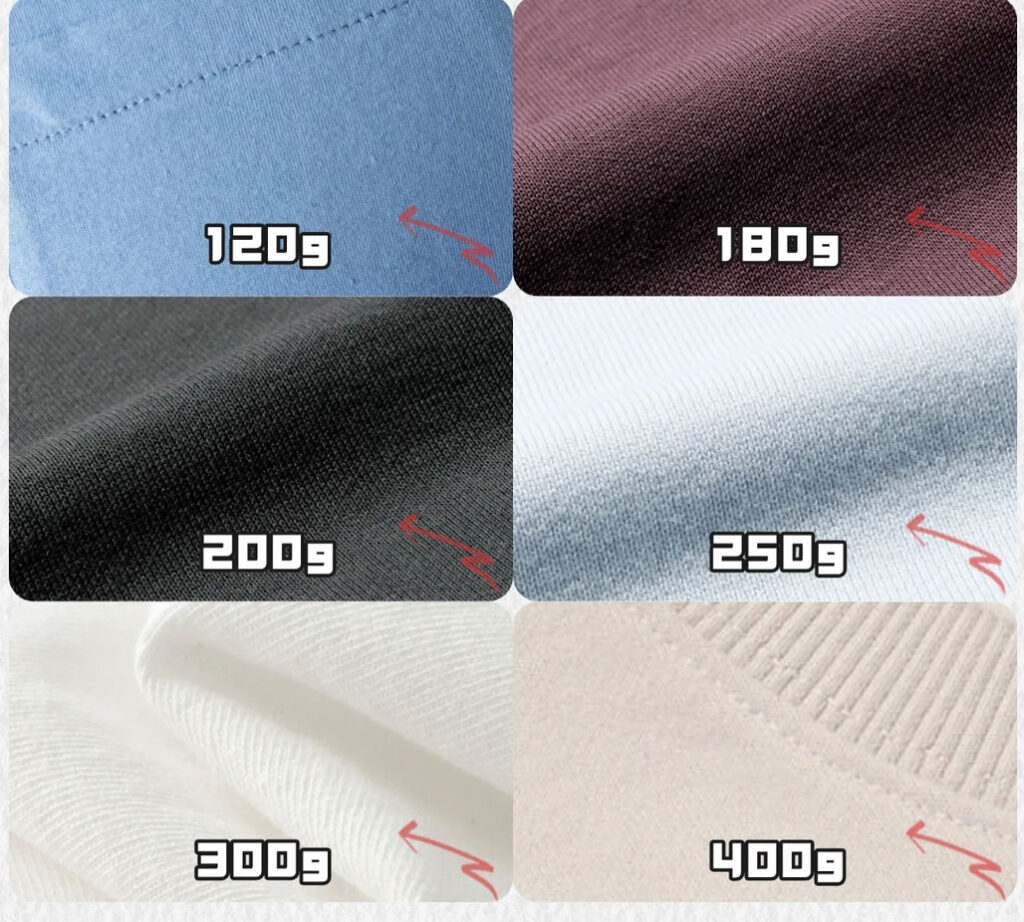
GSM (Grams per Square Meter) refers to the weight of the fabric in grams per square meter. Generally, for yarn of the same quality, the higher the yarn count, the higher the GSM.
Converting the grammage of greige fabric to that of finished fabric using a formula may result in significant discrepancies with reality. This is mainly due to two reasons: while the greige fabric can be calculated using a formula, the closer the conditions are to the actual weight, the more accurate the result. However, because weaving is a physical process, the transformation from greige fabric to finished fabric involves multiple dyeing and finishing processes, resulting in physical and chemical changes in the fabric. This increases the variability, involving various types of machinery and processes, leading to different specifications and standards for each company. Therefore, the conversion between greige fabric and finished fabric grammage varies from company to company.
How to establish a conversion formula?
It is recommended to collect the results of the company’s past greige fabric to finished fabric conversion, then use a computer to screen the most frequent results as the standard, and then evaluate its practicality according to the company’s production situation before establishing a conversion formula.
Example for reference: (General fabrics, general weaving and dyeing processes) Raw weight = Order finished weight x Raw weight coefficient
Fabric greige fabric weight
Plain weave 92% / Double bead 88% / Double-sided garment 89% / Single bead 93% / Single-piece garment 89% / Stretch plain weave 100% / Towel 106% / Double-sided 88% / Stretch rib 91% / Ribbed 83% / Stretch wick 92% / Wick 87%
❶ Fabric weight per unit area: This refers to the weight of the fabric per unit area, usually expressed in grams per square meter (g/m2). The simplest commercial calculation method is:
Weight per square meter (g/m²) = (Weight per meter (g/m)) / (Fabric width (cm)) × 100
For example:
Cotton fabrics generally range from 70 to 250 g/m2;
The weight of varnish (combed) wool fabric is approximately 185 g/m2;
Thick tweed (combed) weighs approximately 280g/m2;
Thin silk fabrics generally range from 20 to 100 g/m2.
The weight per square meter of greige fabric is also one of the quality indicators for evaluating the physical properties of fabrics, which is even more important for wool fabrics. The Ministry-issued standards for combed wool fabrics and wool-type chemical fiber fabrics stipulate that:
if the weight per square meter is less than the allowable tolerance (specified as 5%), it is classified as a first-class product; if it exceeds 5% but does not exceed 7%, it is classified as a second-class product.
❷ Calculation method according to the “Ministry-issued Standard” (moisture regain factor should be deducted):
GK=L×BG0(100+WK)×100
Where: GK—weight per square meter at standard moisture regain (g/m2)
GO—Dry weight of the sample (g)
WK—The standard moisture regain of the sample (%)
L—Sample length (cm)
B—Speed sample width (cm)
The following is an excerpt of the standard moisture regain (WK) of commonly used yarns.
Cotton yarn: 8.5%; Combed wool yarn: 16%; Carded wool yarn: 15%; Polyester/cotton yarn (65/35): 3.2%.
❸ Calculation method for approximate estimation of weight per square meter based on fabric structure factors:
G(g/m2)=100Ntr⋅Ptr+100Ntw⋅Ptw=0.01(Ntr⋅Ptr+Ntw⋅Ptw)
In the formula: NtT — warp yarn tex number (number)
NTw — Weft yarn tex number (size)
PT—Warp density (threads/10cm)
PW—Weft density (threads/10cm)
This calculation formula is an approximation; it does not take into account yarn bending, elongation, and weight changes of the fabric during processing. (Note: tex number refers to the weight (g) of 1000 meters of yarn at standard moisture regain.)
Weight of one square meter of un-sizing dried cotton fabric:
Gj=(1−aj)(1+Sjz)×100Pj×10×gj×(1−Fj)Gw=(1−aw)×100Pw×10×gwG=Gj+Gw
Where: G—the dry weight of one square meter of cotton fabric without sizing (grams);
Gj — Dry weight of warp yarns in one square meter of cotton fabric (grams).
Gw—Dry weight of the weft yarn in one square meter of cotton fabric (grams).
Pj — Warp density of cotton fabric (threads/10 cm)
Pw—Weft density of cotton fabric (threads/10 cm);
gj — Standard dry weight of warp yarn (grams/100 meters);
gw—Standard dry weight of weft yarn (grams/100 meters);
Fj—Total fly waste rate of warp yarns;
aj — warp shrinkage rate;
Sjz—Total elongation of warp yarns;
aw — weft shrinkage rate.
in:
- Standard dry weight of warp and weft yarns (g/100) = Metric yarn count × 0.92166 / 10 or = 53.74 / English yarn count
- The weight of the strands is calculated based on the weight after they are combined.
- Total warp elongation: Sizing single yarn is calculated at 1.2% (of which winding and warping are calculated at 0.5%, and sizing is calculated at 0.7%). For plied yarns below No. 10.2, the calculation is 0.3%; for yarns above No. 10.2, the calculation is 0.7%.
- The elongation of the indirect weft yarn is relatively small and can be ignored.
- Total warp fly rate: 1.2% for coarse count fabrics; 0.6% for medium count plain weave fabrics; 0.9% for twill fabrics; 0.8% for fine count fabrics; and 0.6% for yarn fabrics.
- The total elongation of warp yarns, the total fly rate of warp yarns, and the shrinkage rate of warp and weft yarns are the basis for calculating the weight of one square meter of fabric, not the prescribed indicators.
Simple methods for pricing and estimating yarn consumption in the workshop
Warp yarn usage per 100 meters = warp density/count × width × 0.0065
Weft yarn usage per 100 meters = weft density / yarn count × width × 0.0065
A more reasonable one: (for process engineers)
Warp yarn count per 100 meters = (warp yarn count × total number of warp threads / (1 – warp shrinkage rate)) / 10000 × 1.01
The weft yarn count per 100 meters = weft yarn number × weft density × 3.937 × (reed width + reel yarn) / 100000 × 1.003
Recycled yarn – use 12cm for elastic yarn and 8cm for regular yarn.
This formula is widely used by sales personnel for convenient calculations. The principle is correct and the calculation is simple, but errors are inevitable (is your so-called 101g/m2 absolutely correct? Definitely not, it’s just more precise).
The weight per square meter of grey fabric = (warp density + weft density) × 1.1 × 59 / (2.54 × yarn count) = warp density × 1.1 × 59 / (2.54 × yarn count) + weft density × 1.1 × 59 / (2.54 × yarn count).
a. Warp (weft) density / 2.54 — Convert imperial density to metric density
b. Coefficient 1.1 – This takes into account the warp (weft) shrinkage rate and warp (weft) yarn loss, which is approximately 10%. Although there is a deviation, it is not a major issue for convenient and quick calculation.
c.59/yarn count — This is the conversion of English yarn count to metric yarn count. It takes into account conversion factors such as cotton 583.1 and polyester 590.5, and uses a factor of 590. Although there is some error, it is not a big problem.
Summary from Aung Crown:
Warp a * b * c + Weft a * b * c = Precision + Weft density) * 1.1 * 59 / (2.54 * Yarn count) = Weight per square meter of grey fabric

I have over 25 years of experience in hat and apparel manufacturing. With a steady and detail-oriented approach, I oversee factory production and team operations, ensuring reliable quality and on-time delivery for customers worldwide