As a manufacturer with 28+ years of experience in B2B custom hats and apparel, we deal with custom orders from brand clients, corporate buyers, event agencies, and other B2B partners every day. To be honest, how end consumers choose a T‑shirt that suits them – that’s something brands and retailers should be thinking about. But here’s the reality: if our B‑side clients don’t understand these things, the products they design won’t connect with end users – and that ultimately affects our repeat order rates and brand reputation.
Recently, we came across a comprehensive article on women’s T-shirt selection. It covered everything from size charts and sleeve styles to neckline options, fabric identification, and care instructions. While the article was written for C‑end consumers, a closer read reveals a wealth of supply chain insights that are highly relevant for B2B custom manufacturers and our corporate clients. Today, we want to look at this article through the lens of a B‑side manufacturer of custom hats and apparel, drawing on our years of experience serving brand clients, to reinterpret the key takeaways and offer a practical, actionable T‑shirt customization sourcing guide for our partners.
Sizing Systems: The Hidden Cost Often Overlooked in B2B Procurement
| Size Chart | S | M | L | XL | XXL | XXXL | |
| Shoulder | unit: cm | 52 | 54 | 56 | 58 | 60 | 62 |
| unit: inch | 20.47 | 21.26 | 22.05 | 22.83 | 23.62 | 24.41 | |
| Length | unit: cm | 59.2 | 61 | 62.5 | 64 | 65.5 | 67 |
| unit: inch | 23.31 | 24.02 | 24.61 | 25.20 | 25.79 | 26.38 | |
| Breast | unit: cm | 88 | 92 | 96 | 100 | 104 | 108 |
| unit: inch | 34.65 | 36.22 | 37.80 | 39.37 | 40.94 | 42.52 | |
| Hem | unit: cm | 84 | 88 | 92 | 96 | 100 | 104 |
| unit: inch | 33.07 | 34.65 | 36.22 | 37.80 | 39.37 | 40.94 | |
| Cuff | unit: cm | 30 | 31 | 32 | 33 | 34 | 35 |
| unit: inch | 11.81 | 12.20 | 12.60 | 12.99 | 13.39 | 13.78 | |
Here is a detailed women’s T‑shirt size chart from S to XXXL is simply a matter of “which size should I buy?” But for B2B buyers, the sizing system conceals significant cost variables.
The first variable is size distribution accuracy. Many brand clients default to an even split across S, M, L, and XL, say, 25% each. But here’s what the numbers actually say: size distribution is far from uniform. It shifts dramatically depending on the style and who’s buying. Fitted T‑shirts in size M can easily account for more than 40% of sales. On the other hand, oversized or relaxed styles? L and XL together can top 60%. Stocking in equal proportions almost guarantees a dual hit: slow‑moving stock on one end and stockouts on the other, both of which eat directly into margins.
The second variable is the granularity of body type codes. The article explains that “type” refers to net chest or waist circumference, while “body type codes” (Y, A, B, C) indicate the difference between chest and waist measurements. Many B‑side clients focus solely on “height codes” and overlook “type” and body type codes. The result? Consumers of the same height can have very different chest and waist measurements. If you stock only by height, return rates will climb. Our recommendation: define your target customers’ body type profile at the design planning stage, and adjust the cut and size grading accordingly.
The third variable is size conversion for cross‑border orders. For brand clients in export markets, the difference between US/EU sizing and Asian sizing cannot be ignored. The size chart in the article is based on Asian body standards. If your products are destined for US or European markets, the fit needs to be adjusted at the pattern level – not simply swapping a “M” label for an “S” label.
Style Design: Sleeve and Neckline Selection Logic for B‑Side Buyers
Here we are devoting considerable space to sleeve and neckline options for women’s T‑shirts:
1. Sleeve Types
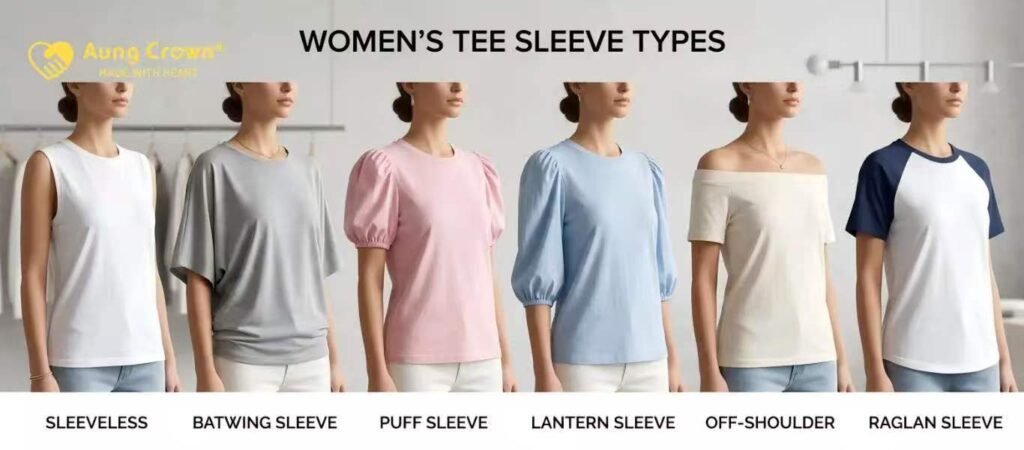
Sleeves: Sleeveless styles are not suitable for broad shoulders; batwing sleeves work well for those with fuller arms; puff sleeves can conceal thicker forearms but are not ideal for those with broad shoulders and full arms; lantern sleeves suit women with fuller arms; off‑shoulder styles flatter broad‑shouldered figures; raglan sleeves are specifically designed for women with broader shoulders.
2. Neckline Types
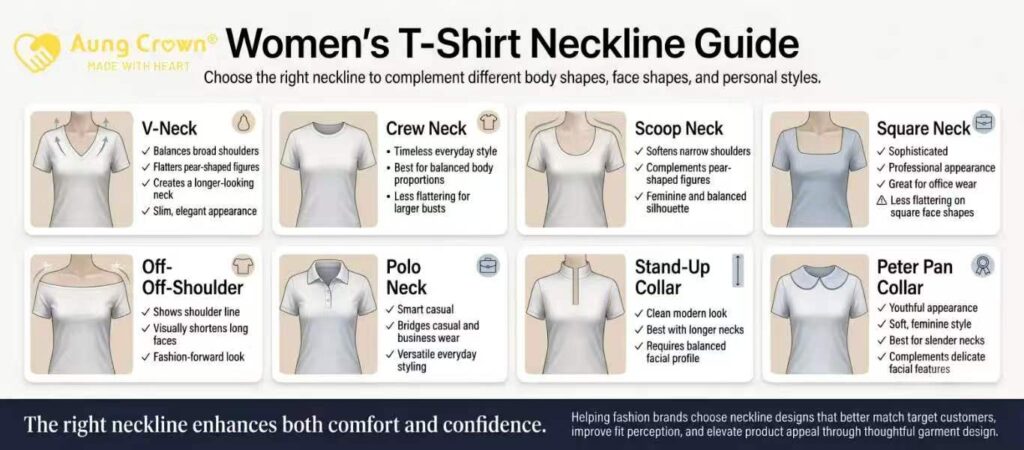
Necklines: V‑necks help balance broad shoulders and pear‑shaped figures, while also elongating the neck; crew necks are not ideal for larger busts; scoop necks can refine narrow shoulders and pear‑shaped figures; square necks project a poised, professional look but are less flattering on square faces; off‑shoulder necklines visually shorten long faces; polo necks bridge the gap between casual and formal; stand‑up collars require a certain neck length and profile to pull off; Peter Pan collars have a youthful, age‑reducing effect but suit sweet features and slender necks.
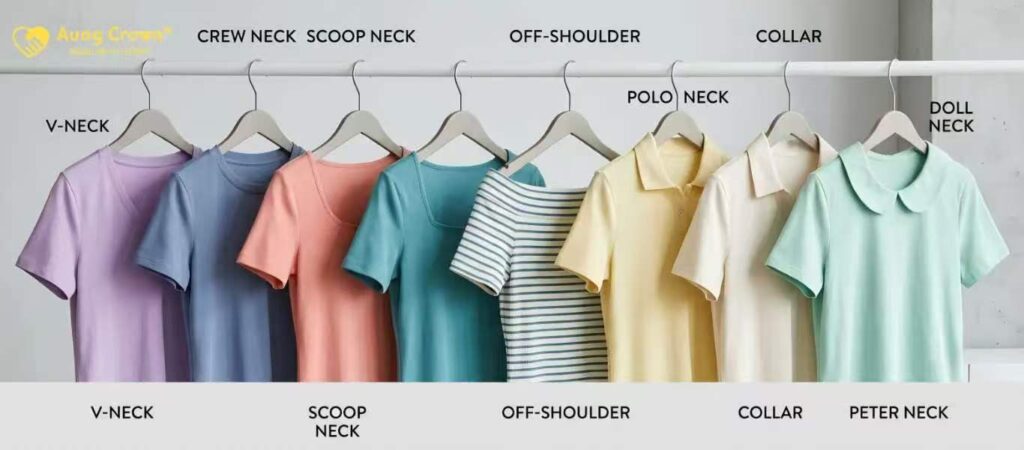
How to Choose The Right Tee?
For C‑end consumers, this is a “how to look good” guide. For B‑side clients, it’s a “what styles will sell” decision‑making framework. Drawing on our supply chain experience, we’ve distilled the following selection logic:
- First, your target customer determines the priority of sleeve and neckline choices. If your target audience is 25‑35‑year‑old professional women, a combination of V‑necks and polo necks may be the optimal solution – offering both workplace appropriateness and body‑shaping functionality. If you’re designing for young women in the 18‑25 bracket, think off‑shoulder, one‑shoulder necklines, and raglan sleeves – these styles tend to really resonate with them. On the other hand, if your audience is women over 40, square necks and Peter Pan collars tend to be much more appealing.
- Second, style complexity directly impacts production costs and lead times. Special sleeve styles such as raglan, tulip, and flared sleeves require higher skill levels and longer processing times in cutting, sewing, and ironing compared to standard set‑in sleeves. B‑side clients need to weigh design appeal against cost and delivery constraints. We often encounter this scenario: a client brings in a striking design for a quote, but the production cycle is 45 days – and they only have 30 days. In such cases, compromises on complexity are unavoidable.
- Third, functional requirements are emerging as a new growth driver. Increasingly, corporate buyers are moving beyond basic “print‑a‑logo” customization and expecting the T‑shirts themselves to be functional – for example, moisture‑wicking properties for outdoor sports brands, or wrinkle‑resistant, easy‑care finishes for hospitality uniforms. These functional needs are often achieved through fabric selection and finishing processes, not just style‑level adjustments.
Fabric Selection: The “Cost‑Performance” Myth and Reality in B‑Side Procurement
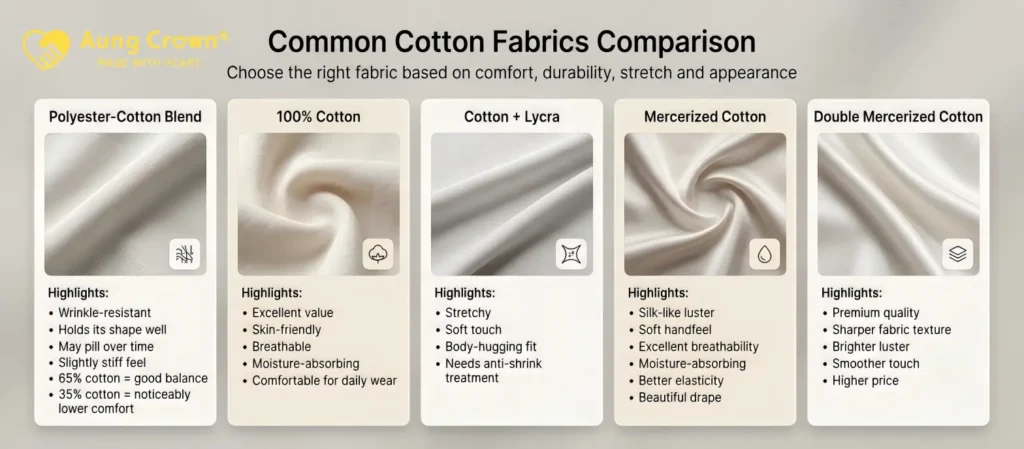
This part is going to introduce a detailed breakdown of five commonly used fabrics for women’s T‑shirts:
- Polyester‑cotton blend (cotton + polyester): Wrinkle‑resistant and shape‑retentive, but prone to pilling and tends to feel stiff on the skin. A 65% cotton blend is acceptable; 35% cotton is noticeably inferior.
- 100% cotton: Offers great value for money, with excellent skin‑friendliness, breathability, and moisture absorption.
- Cotton + Lycra (spandex): Stretchy, soft to the touch, and form‑fitting – but requires anti‑shrinkage treatment to maintain sizing.
- Mercerized cotton: Processed through singeing and mercerization, giving it a silk‑like sheen, soft handfeel, superior moisture absorption and breathability, plus excellent elasticity and drape.
- Double mercerized cotton: A step above regular mercerized cotton – with clearer fabric texture, brighter luster, and a smoother handfeel – but comes at a higher price point.
Fabric selection is where B‑side buyers most often fall into the “cost‑performance trap.” Many clients instinctively go for the cheapest option. But our experience tells us a different story: while fabric accounts for about 40–50% of a T‑shirt’s total cost, it influences over 70% of the end‑consumer experience. In other words, the money you save on fabric often comes back to haunt you in higher return rates, poorer reviews, and lower repurchase rates.
Our recommendations by application scenario:
- Promotional event T‑shirts (single‑use, budget‑constrained): A polyester‑cotton blend is acceptable – but the cotton content should be no less than 60%. For promotional T‑shirts, this strikes a sensible balance between budget and comfort – so the end user doesn’t feel like throwing it away after one wear.
- Corporate uniform T‑shirts (daily wear, frequent washing): When it comes to corporate uniforms that are worn daily and washed frequently, 100% cotton is the clear value champion – offering reliability, comfort, and cost‑effectiveness in equal measure. The breathability and skin‑friendliness of natural fibers make them suitable for long hours of wear, and comfort levels don’t degrade significantly after repeated washing. However, be sure to apply anti‑shrinkage and wrinkle‑resistant finishes – otherwise, the T‑shirts will lose their shape after just a few washes.
- Brand retail T‑shirts (quality‑ and image‑focused): Mercerized cotton or double mercerized cotton is the preferred choice. The luster and drape of these fabrics significantly elevate the product’s perceived quality, supporting higher retail price points. As the article also cautions, mercerized and double mercerized cotton require specialized handling in sewing and printing/embroidery – it’s recommended to work with manufacturers who specialize in premium T‑shirts. This isn’t just marketing speak; it’s a genuine technical threshold — ordinary factories simply don’t have the equipment or expertise to handle fine printing and embroidery on mercerized cotton.
- Sports and activewear T‑shirts (requiring stretch and a close fit): When it comes to sports and activewear T‑shirts – you want stretch, you want a close fit, and you want comfort that lasts. That’s where cotton + Lycra (spandex) shines. The spandex adds just the right amount of elasticity and crease recovery, so the fabric moves with you – no matter how intense the activity. Just be sure to apply anti‑shrinkage treatment, otherwise post‑wash shrinkage will throw off the sizing.
Care & Maintenance: The Hidden Value in B‑End Product Labels
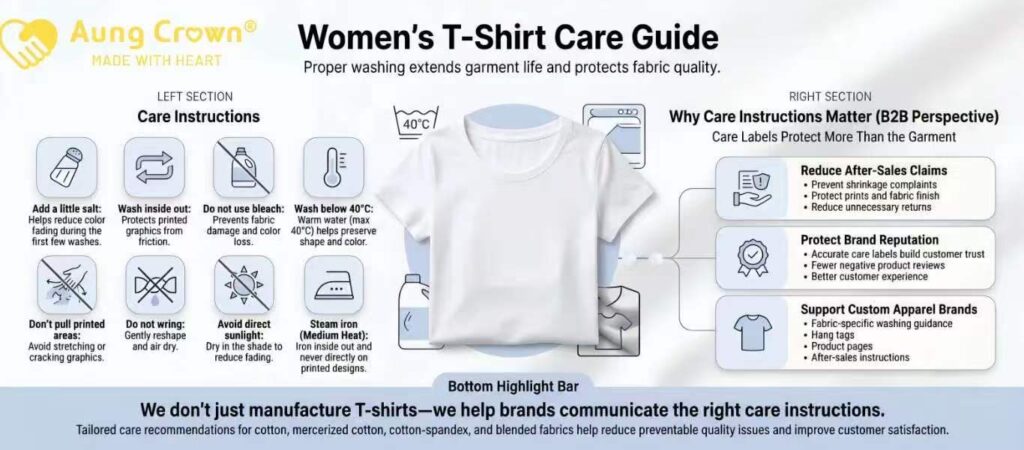
This part is a section on washing and maintenance tips for women’s T‑shirts: adding salt to prevent fading, turning the garment inside out to avoid rubbing printed designs, avoiding bleach, washing in warm water below 40°C, not pulling or ironing printed areas, avoiding wringing when drying, keeping out of direct sunlight, and using medium‑temperature steam ironing.
Many B‑side clients treat care instructions as nothing more than standard boilerplate text on a hang tag – something to copy and paste without much thought. In reality, care instructions are a critical tool for reducing after‑sales disputes and building brand professionalism.
Consider this: a 100% cotton T‑shirt without a clear “do not tumble dry” or “wash in cold water” warning. The consumer buys it, runs it through a hot dryer once, and it shrinks two sizes – then comes back asking for a refund. Who bears the cost? Or take a mercerized cotton T‑shirt: the consumer washes it with bleach‑based detergent, and the luster is gone after one wash. They leave a negative review – “Poor quality, fell apart after one wash” – when the real issue was the washing method, not the product quality.
That’s why, in our custom manufacturing service for B‑side clients, we adhere to one principle: we don’t just make the product – we help our clients make the product instructions right. For T‑shirts made from different fabrics, we provide tailored care recommendations – helping brand clients communicate accurate maintenance information on hang tags, product pages, and in after‑sales communication – reducing preventable issues at the source.
Summary Recommendations for B‑Side Partners
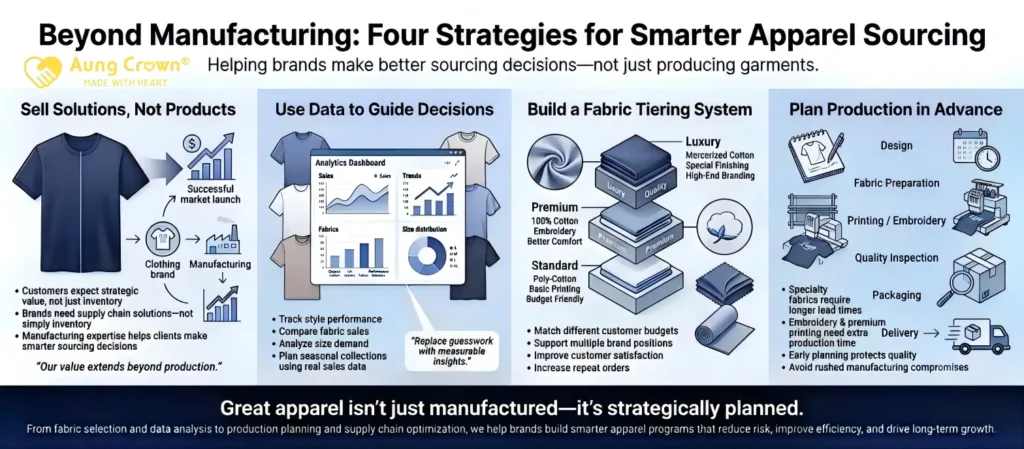
Based on the analysis above, we’d like to offer a few core recommendations for B‑side partners who are either considering or already engaged in T‑shirt customization:
First, shift from “selling products” to “selling solutions.” End consumers don’t need a T‑shirt – they need a version of themselves that looks great in what they’re wearing. Brand clients don’t need a batch of goods – they need a supply chain solution that helps them sell more. As a B2B manufacturer, our value lies not just in production, but in using our expertise to help clients make better sourcing decisions.
Second, prioritize data‑driven product selection. The knowledge in the article is static industry wisdom – but the truly valuable decision‑making inputs come from dynamic sales data. We recommend that B‑side clients establish their own sales data feedback mechanisms – tracking actual performance across different styles, fabrics, and sizes – and using that data to guide future seasonal planning and inventory decisions.
Third, build a fabric and process “tiering system.” Not every client needs mercerized cotton, and not every client is limited to polyester‑cotton blends. Establishing a clear fabric and process tiering system – allowing clients with different budgets and brand positions to find solutions that work for them – is key to improving customer satisfaction and repurchase rates.
Fourth, plan production lead times in advance. Special sleeve styles, mercerized cotton fabrics, and fine printing or embroidery all require longer production cycles. B‑side clients need to factor these time costs into their product planning from the outset – avoiding the trap of having to compromise on quality because of tight delivery deadlines.
FAQs: Common Questions from Corporate Buyers

Having studied in the U.S., I now lead the global digital operations at Aung Crown. My passion lies in blending fashion trends and musical inspiration into the B2B landscape, allowing me to share the unique craftsmanship of Chinese hat-making with a global audience.