Summer Sock Fibers: A Detailed Guide to Cool, Odor‑Free Comfort
This article is brought to you by Aung Crown team, Aung Crown – a professional custom manufacturer with nearly 30 years of experience in hat-making, garment-making, and accessory-making. Drawing on the latest material research, we break down the science of sock fabric selection. While our focus is on what goes on your head, our understanding of fabrics runs deep, and great materials work the same way, whether you’re wearing them on your feet or on your crown.
Why You Cannot Choose the Right Socks?
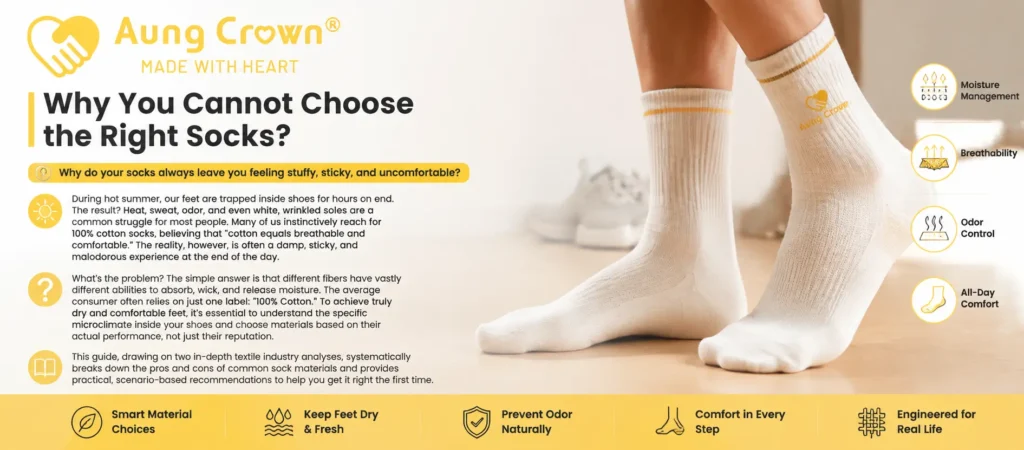
Ever wonder why your socks always leave you feeling hot, sticky, and miserable?
Summer means our feet are trapped in shoes for hours – and with that comes heat, sweat, odor, and sometimes even white, pruned soles. Most of us reach for 100% cotton socks, convinced that “cotton = breathable.” But by the end of the day, we’re left with damp, sticky, and not‑so‑fresh feet.
So what’s going on? Different fibers absorb, wick, and release moisture in completely different ways. Yet most shoppers only read one label: “100% Cotton.” If you want dry, comfortable feet, you need to understand the micro‑climate inside your shoes – and pick materials based on real performance, not hype.
This guide, drawing on two in‑depth textile industry analyses, systematically breaks down the pros and cons of common sock materials and provides practical, scenario‑based recommendations to help you get it right the first time.
Common Sock Materials: A Detailed Breakdown
1. Pure Cotton – The King of Comfort, but a Summer “Moisture Trap”
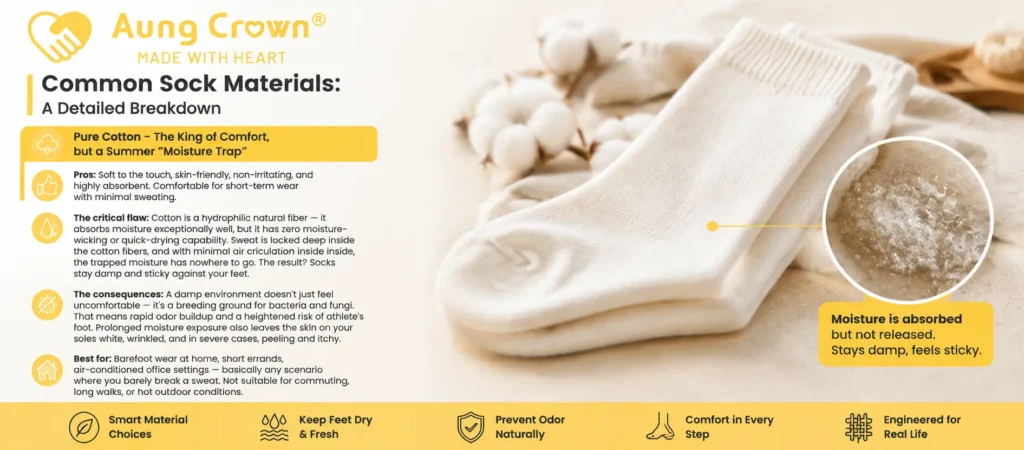
Pros: Soft, gentle, and highly absorbent – great for light, short‑term wear.
Cons: Cotton soaks up sweat but can’t release it. With poor air circulation inside shoes, moisture gets trapped, leaving socks damp and stuffy all day.
The fallout: Constant dampness fuels bacteria and fungi – leading to odor, athlete’s foot, and wrinkled, irritated skin.
Best for: Home wear, short errands, or air‑conditioned offices – not for commuting, walking, or hot weather.
2. Nylon – The Breathable–Feeling Fiber, but Keep an Eye on Ventilation
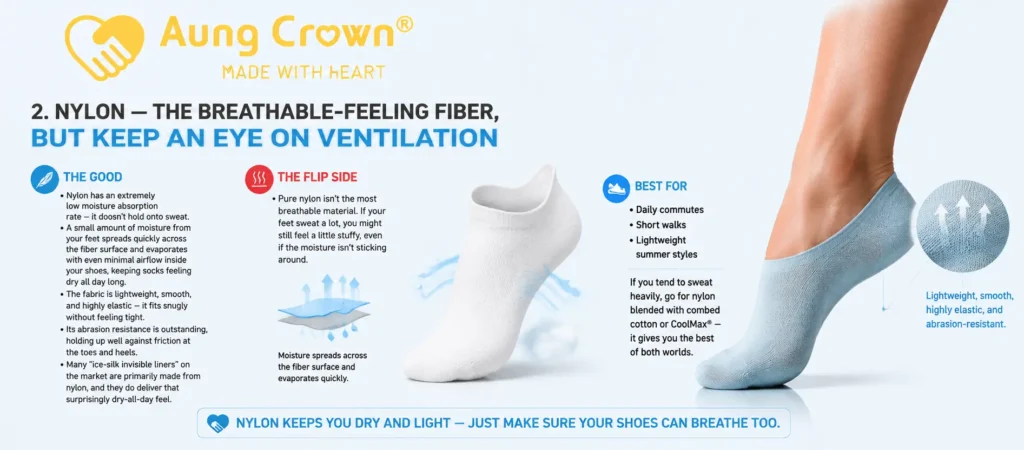
Pros: Nylon has an extremely low moisture absorption rate – it doesn’t hold onto sweat. A small amount of moisture from your feet spreads quickly across the fiber surface and evaporates with even minimal airflow inside your shoes, keeping socks feeling dry all day long. The fabric is lightweight, smooth, and highly elastic – it fits snugly without feeling tight, and its abrasion resistance is outstanding, holding up well against friction at the toes and heels. Many “ice‑silk invisible liners” on the market are primarily made from nylon, and they do deliver that surprisingly dry‑all‑day feel.
The flip side: Pure nylon isn’t the most breathable material. If your feet sweat a lot, you might still feel a little stuffy, even if the moisture isn’t sticking around.
Best for: Daily commutes, short walks, and lightweight summer styles. If you tend to sweat heavily, go for nylon blended with combed cotton or CoolMax® – it gives you the best of both worlds.
3. Modal & Tencel – The Perfect Balance of Moisture Absorption and Cooling Sensation
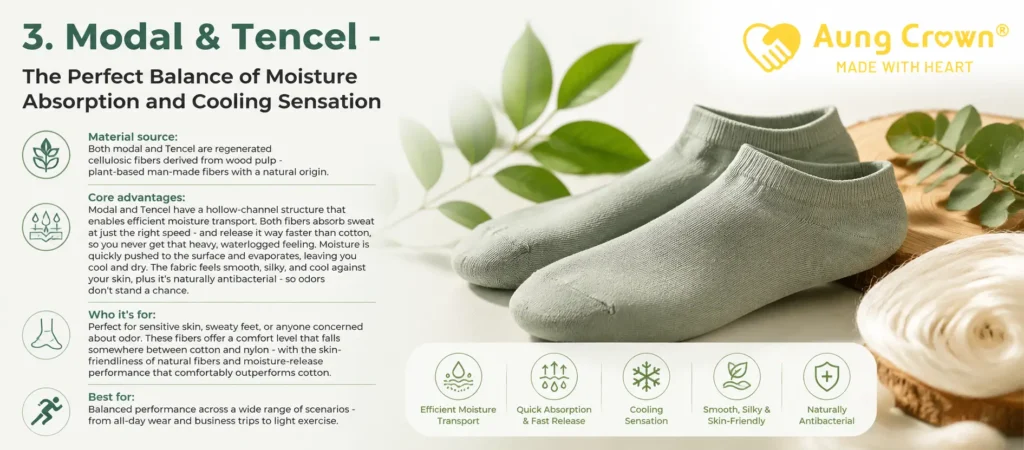
Material source: Both modal and Tencel are regenerated cellulosic fibers derived from wood pulp – plant-based man‑made fibers with a natural origin.
Core advantages: Modal and Tencel have a hollow‑channel structure that enables efficient moisture transport. Both fibers absorb sweat at just the right speed – and release it way faster than cotton, so you never get that heavy, waterlogged feeling. Moisture is quickly pushed to the surface and evaporates, leaving you cool and dry. The fabric feels smooth, silky, and cool against your skin, plus it’s naturally antibacterial – so odors don’t stand a chance.
Who it’s for: Perfect for sensitive skin, sweaty feet, or anyone concerned about odor. These fibers offer a comfort level that falls somewhere between cotton and nylon – with the skin‑friendliness of natural fibers and moisture‑release performance that comfortably outperforms cotton.
Best for: Balanced performance across a wide range of scenarios – from all-day wear and business trips to light exercise.
4. CoolMax® & Quick-Dry Fibers – The Heavy-Sweat Game Changer
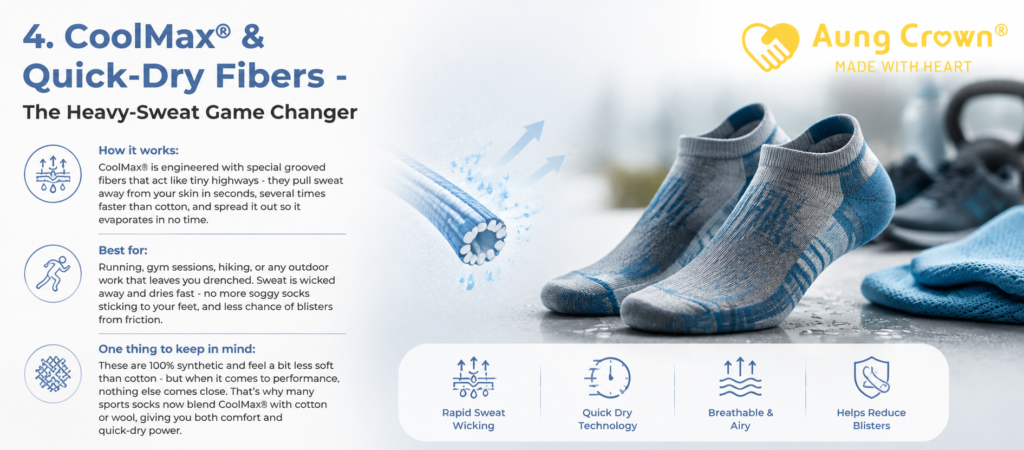
How it works: CoolMax® is engineered with special grooved fibers that act like tiny highways – they pull sweat away from your skin in seconds, several times faster than cotton, and spread it out so it evaporates in no time.
Best for: Running, gym sessions, hiking, or any outdoor work that leaves you drenched. Sweat is wicked away and dries fast – no more soggy socks sticking to your feet, and less chance of blisters from friction.
One thing to keep in mind: These are 100% synthetic and feel a bit less soft than cotton – but when it comes to performance, nothing else comes close. That’s why many sports socks now blend CoolMax® with cotton or wool, giving you both comfort and quick‑dry power.
Do Those “Antibacterial, Anti‑Odor” Socks Really Work?
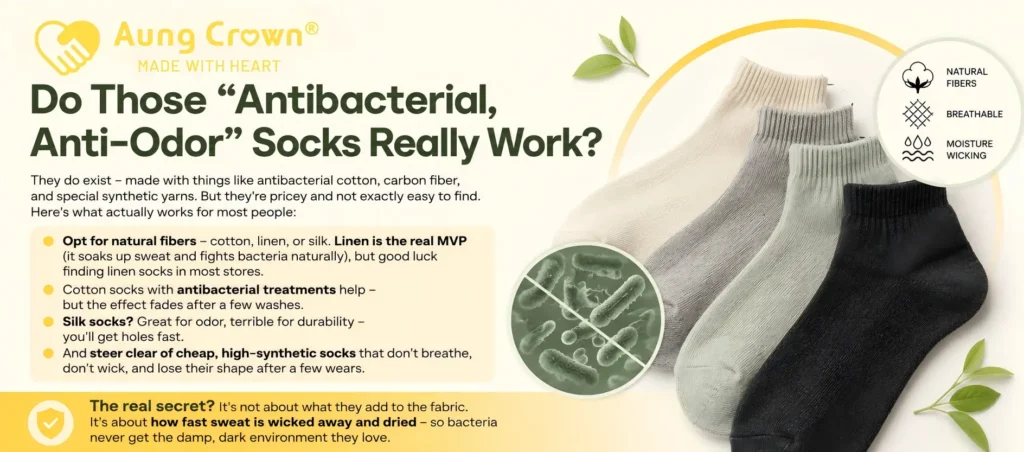
They do exist – made with things like antibacterial cotton, carbon fiber, and special synthetic yarns. But they’re pricey and not exactly easy to find.
Here’s what actually works for most people:
- Opt for natural fibers – cotton, linen, or silk. Linen is the real MVP (it soaks up sweat and fights bacteria naturally), but good luck finding linen socks in most stores.
- Cotton socks with antibacterial treatments help – but the effect fades after a few washes.
- Silk socks? Great for odor, terrible for durability – you’ll get holes fast.
- And steer clear of cheap, high‑synthetic socks that don’t breathe, don’t wick, and lose their shape after a few wears.
The real secret? It’s not about what they add to the fabric. It’s about how fast sweat is wicked away and dried – so bacteria never get the damp, dark environment they love.
The Comparison Table of Sock Fabrics
| Fabrics | Moisture-wicking | Quick-dry | Breathability | Skin-friendly | Durability | Best For |
| 100% Cotton | ★★★★★ | ★ | ★★★ | ★★★★★ | ★★★ | Indoor and short leisure times |
| Nylon | ★ | ★★★★★ | ★★★ | ★★★ | ★★★★★ | Commuting and summer no-show socks |
| Modal/Tencel | ★★★★ | ★★★★ | ★★★★ | ★★★★★ | ★★★ | Long-time wearing and peple with sensitive skin |
| CoolMax | ★★(It doesn’t absorb sweat, but it wicks it away extremely fast.) | ★★★★★ | ★★★★ | ★★(more like smooth) | ★★★★ | Sports and sweat a lot sense |
| Linen | ★★★★★ | ★★★★ | ★★★★★ | ★★(a little stiff) | ★★★ | Premium Antimicrobial Protection |
What Textile Industry Trends Tell Us About Sock Material Selection
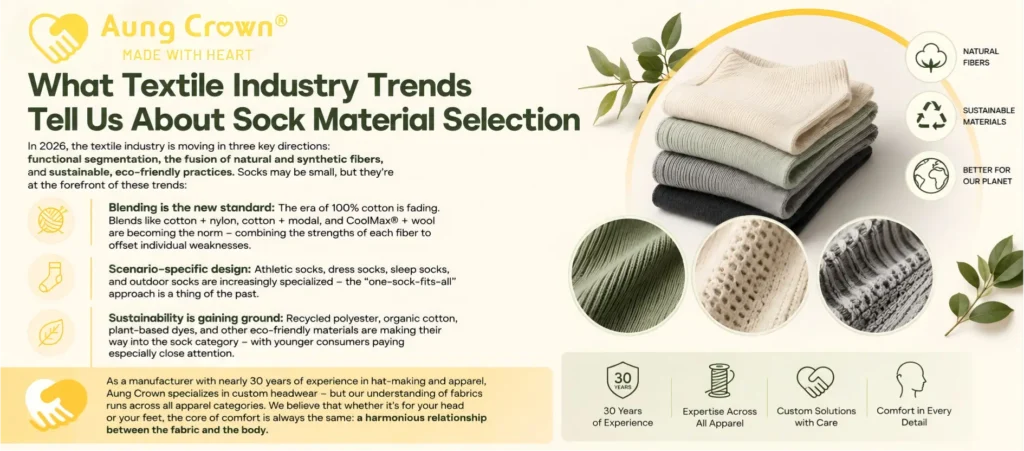
Textile trends in 2026: performance‑tailored materials, natural‑synthetic blends, and sustainability. Socks are a prime example of where these trends are heading:
- Blending is the new standard: The era of 100% cotton is fading. Blends like cotton + nylon, cotton + modal, and CoolMax® + wool are becoming the norm – combining the strengths of each fiber to offset individual weaknesses.
- Scenario‑specific design: Athletic socks, dress socks, sleep socks, and outdoor socks are increasingly specialized – the “one‑sock‑fits‑all” approach is a thing of the past.
- Sustainability is gaining ground: Recycled polyester, organic cotton, plant‑based dyes, and other eco‑friendly materials are making their way into the sock category – with younger consumers paying especially close attention.
As a manufacturer with nearly 30 years of experience in hat-making and apparel, Aung Crown specializes in custom headwear – but our understanding of fabrics runs across all apparel categories. We believe that whether it’s for your head or your feet, the core of comfort is always the same: a harmonious relationship between the fabric and the body.
Three Golden Rules for Choosing Socks
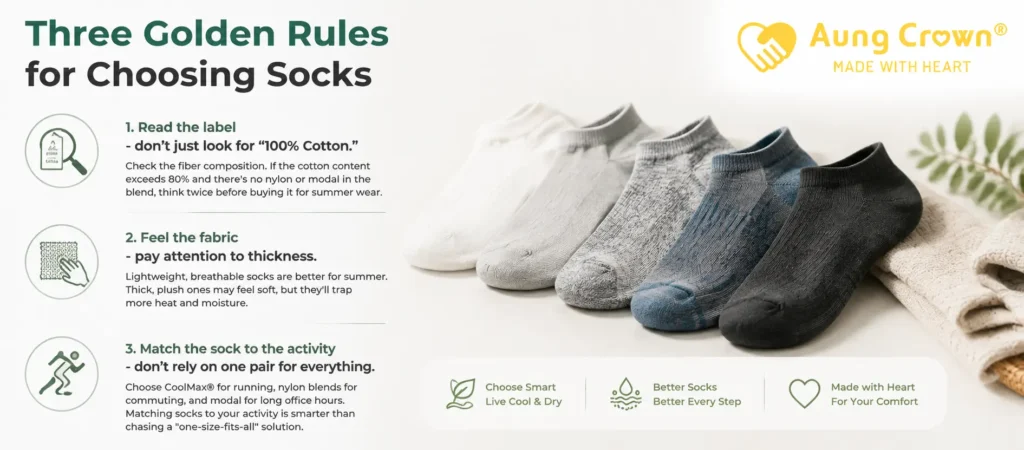
- Read the label – don’t just look for “100% Cotton.” Check the fiber composition. If the cotton content exceeds 80% and there’s no nylon or modal in the blend, think twice before buying it for summer wear.
- Feel the fabric – pay attention to thickness. Lightweight, breathable socks are better for summer. Thick, plush ones may feel soft, but they’ll trap more heat and moisture.
- Match the sock to the activity – don’t rely on one pair for everything. Choose CoolMax® for running, nylon blends for commuting, and modal for long office hours. Matching socks to your activity is smarter than chasing a “one-size-fits-all” solution.
Conclusion
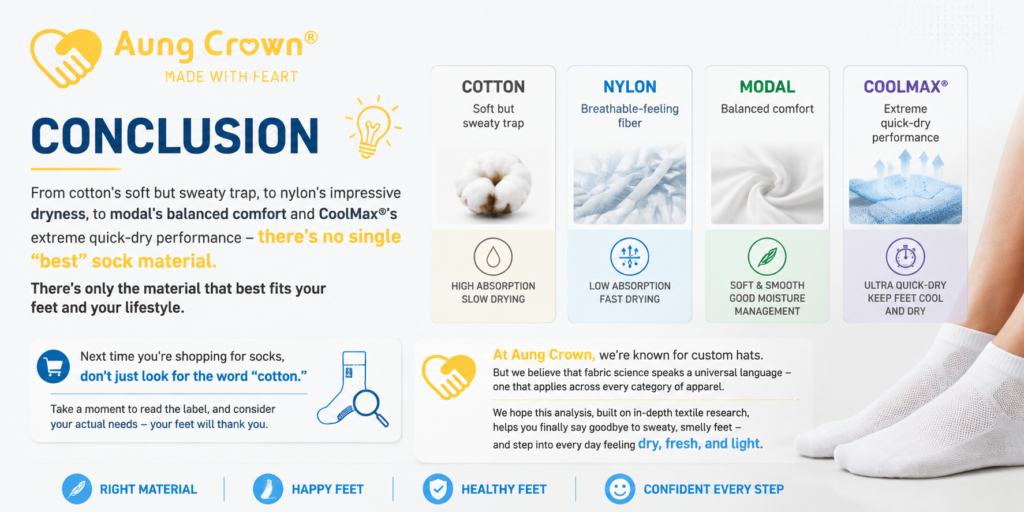
From cotton’s soft but sweaty trap, to nylon’s impressive dryness, to modal’s balanced comfort and CoolMax®’s extreme quick-dry performance – there’s no single “best” sock material. There’s only the material that best fits your feet and your lifestyle.
Next time you’re shopping for socks, don’t just look for the word “cotton.” Take a moment to read the label, and consider your actual needs – your feet will thank you.
At Aung Crown, we’re known for custom hats. But we believe that fabric science speaks a universal language – one that applies across every category of apparel. We hope this analysis, built on in-depth textile research, helps you finally say goodbye to sweaty, smelly feet – and step into every day feeling dry, fresh, and light.
FAQs – 9 Common Questions About Socks
About Aung Crown: Founded in Shenzhen in 1998, Aung Crown is a globally leading custom manufacturer of hats and apparel, with products exported to over 100 countries. We are committed to integrating fabric science and ergonomics into every hat we make, offering global brand clients a one-stop custom service from design to delivery. Learn more: www.aungcrown.com

Having studied in the U.S., I now lead the global digital operations at Aung Crown. My passion lies in blending fashion trends and musical inspiration into the B2B landscape, allowing me to share the unique craftsmanship of Chinese hat-making with a global audience.