The Dragon Boat Festival is a traditional festival in China with thousands years of history. Here are traditional customs passed down through generations such as hanging mugwort, weaving five‑colored threads, and sewing sachets. In ancient times, people gathered natural plants, boiled them into dye pigments, and soaked fabrics to make new cloth, praying for safety and purification of body and mind. Nowadays, during the Dragon Boat Festival, it’s filled with the fragrance of mugwort. This plant‑based dyeing technique is known as tie‑dye, which was called jiao xie in ancient times. Today, tie‑dye using natural dyes from mugwort and indigo has become a popular craft for this year’s Dragon Boat Festival Guochao (China‑chic) apparel.
Interpreting the 2026 Dragon Boat Festival Tie‑Dye Guochao (China‑chic) Apparel Market from a B2B Custom Manufacturer’s Perspective
During the 2026 Dragon Boat Festival holiday, tie‑dye Guochao (China‑chic) apparel emerged as a dark horse in the consumer market. Meituan data shows that search interest in “tie‑dye experiences” has recently surged by 75% year‑on‑year. Looking at the broader Guochao (China‑chic) apparel sector, the market exceeded RMB 220 billion in 2024, jumped to over RMB 250 billion in 2025, and is expected to sustain growth of over 15% in 2026. As practitioners deeply engaged in B2B custom manufacturing, we need to look beyond the festive marketing spectacle and understand the industrial logic behind this “tie‑dye fever” – it is not just a consumption spike tied to the Dragon Boat Festival, but a typical example of Guochao apparel evolving from “festival best‑seller” to “category staple.”
Mugwort-Dyed Summer Wear
Green and Misty Blue Tie‑Dye Defines a Fresh Dragon Boat Festival Style

This year’s Dragon Boat Festival tie‑dye designs are noticeably more restrained and practical. Instead of piling on high‑saturation color contrasts or covering garments with straightforward festive motifs like dragon boats and zongzi, the overall direction has shifted toward an understated, elegant Guochao (China‑chic) aesthetic – pieces that work for daily wear, commuting, and casual outings, appealing to a broader audience.
In terms of color, two plant‑based primary shades dominate the market: the soft greenish tone achieved with mugwort dye, and the misty gray‑blue extracted from indigo. Both hues carry the natural warmth and texture of plant materials, perfectly capturing the atmosphere of the Dragon Boat season. Among them, the double‑dyed style combining green with misty blue has become the season’s top seller in stores.
When it comes to pattern design, the industry favors a minimalist, white‑space approach. Rather than covering the entire garment with folk motifs, designers use tie‑dye to create localized, gradient accents on cuffs and hemlines – featuring subtle Dragon Boat elements like calamus, rippling water, and gourds. The result is understated and light, never looking dated or overly formal in everyday wear.
The preferred silhouettes are relaxed, light New Chinese Style – loose‑fitting tops, flowing trousers, and lightweight modernized qipaos are all popular choices. Children’s collections mostly feature two‑piece thin Hanfu styles, balancing festive flair with the comfort and freedom kids need for outdoor play.
The market has also formed a clear tiered structure: on one side, there are small‑batch, high‑end handcrafted tie‑dye pieces; on the other, mass‑produced garments for the general consumer, which can ensure that consumers with different budgets and preferences can find something that suits them.
Choosing the Right Fabric
Top Summer Picks for Plant‑Based Tie‑Dye

With the hot summer weather, fabrics used for tie‑dye must meet two core requirements: on one hand, they need to work well with plant‑based dyes to produce natural, layered gradients; on the other, they must be lightweight and breathable for everyday wear and festive outings. Currently, four fabric types are most widely used for Dragon Boat Festival plant‑based tie‑dye: ramie, acetate, Tencel, and high‑count lightweight cotton.
Ramie is the top choice for tie‑dye. Ramie is breathable, heat‑dissipating, and naturally antibacterial, with a natural, slightly coarse texture that gives it an artistic, rustic feel, and it absorbs plant dyes beautifully, often retaining a subtle mugwort fragrance after dyeing. Blended cotton‑ramie fabrics now available on the market have improved on pure ramie’s tendency to wrinkle easily, offering better shape retention – making them the preferred choice for Guochao dresses and casual sets.
Acetate targets the mid‑to‑high‑end Guochao segment. Acetate is smooth, drapes well, resists wrinkling, and requires minimal ironing. Tie‑dye colors transition softly on acetate, like ink washes, giving it an elegant, luminous quality. It is commonly used for modernized qipaos and long festive Dragon Boat dresses, offering a sophisticated, refined look.
Tencel is cool, soft, and lightweight – breathable without trapping heat. It takes plant dyes cleanly and evenly, resulting in a pure, translucent finish. The fabric is highly skin‑friendly, making it ideal for sun‑protective cardigans and girls’ Guochao dresses. Even those with sensitive skin can wear it comfortably against the body.
High‑count lightweight cotton offers outstanding cost‑performance. It dyes evenly with good colorfastness, is soft and gentle on the skin, and blended cotton versions add durability. This fabric is the go‑to choice for affordable Guochao ready‑to‑wear and children’s Dragon Boat Festival attire, reaching the broadest consumer base.
Yongxin Ramie & Cotton, a specialist in the ramie‑cotton fabric sector, offers a wide range of pure ramie, linen‑cotton blends, Tencel, sand‑washed, semi‑bleached, printed, and jacquard series. Leveraging years of experience in ramie weaving, the company provides integrated services from greige fabric development and sampling to bulk supply, supported by comprehensive quality control testing – strictly managing shrinkage, colorfastness, and skin‑friendliness – while keeping pace with seasonal Guochao fashion trends to continuously update its fabric offerings.
One Tie, One Dye – Dyeing Methods
Fabric Determines the Effect of Tie‑Dye Craftsmanship
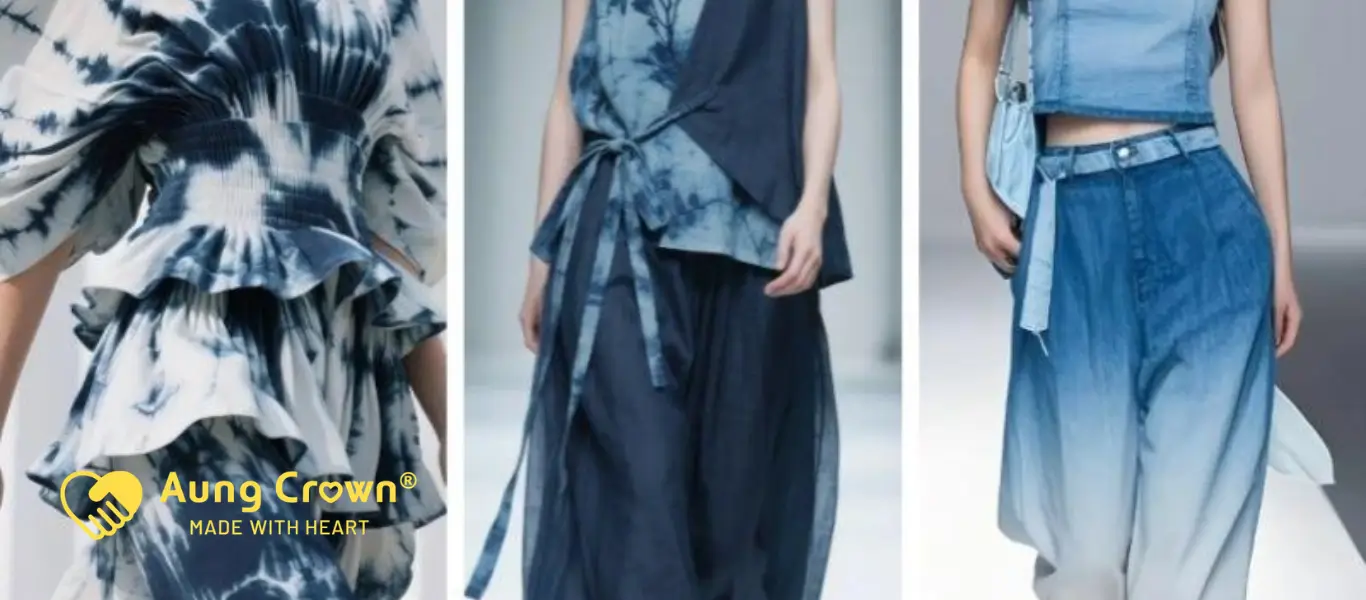
Fabric is the key factor in determining the quality of plant‑based tie‑dye gradients. The texture and thickness of the material directly affect the binding, dye uptake, and final appearance. Tie‑dye consists of three main steps: binding and resist‑dyeing, plant‑based dyeing, and rinsing and color‑fixing. The four mainstream techniques each suit different fabrics, and all are compatible with Dragon Boat Festival plant‑based dyes.
- Cloud‑style bundled dyeing is the most widely used technique. After twisting and binding the fabric, multiple dips create natural cloud‑like gradients. Ramie and lightweight cotton produce rich layered effects, while Tencel and viscose offer smooth, flowing results – most summer garments work well with this method, which has a high tolerance for variation.
- Bamboo‑wood clamp dyeing focuses on fine details. Clamps are used to create neat patterns such as leaves and water ripples. It works best on flat, tightly woven fabrics like pure cotton and linen‑cotton blend semi‑bleached materials. This technique is often used for decorative accents on plackets and collars, fitting mid‑to‑high‑end Guochao apparel.
- Hand‑stitched tie‑dye is a fine manual process. Needle‑and‑thread pre‑stitching outlines motifs like mugwort or auspicious patterns. It pairs well with smooth, even fabrics such as high‑count cotton and acetate, which resist dye bleeding. This method is typically used for limited‑edition pieces and small‑batch fabric sachets.
- Segmented spray dyeing is suitable for mass production. Machine‑controlled zone dyeing minimizes color variation and works well with sand‑washed cotton and lightweight knitted fabrics, ensuring even color application. It is the mainstream process for affordable Guochao T‑shirts and sun‑protective jackets.
Compared to synthetic dyes, plant‑based dyes like mugwort and indigo – paired with breathable fabrics such as ramie, cotton, and Tencel – are gentle on the skin and won’t cause stuffiness, perfectly aligning with summer comfort and the natural, herbal spirit of the Dragon Boat Festival.
Through the evolution of Dragon Boat Festival plant‑dyeing customs, tie‑dye has become an important design language that brings traditional folk culture into the modern apparel market. The 2026 Dragon Boat Festival tie‑dye trend centers on natural plant‑based colors and simple, wearable silhouettes, using a diverse range of fabrics – ramie, acetate, Tencel, and cotton – to balance festive character with summer wearing needs. The deep integration of fabric and dyeing techniques continues to drive innovation in Guochao apparel, bringing new development opportunities to the textile industry’s seasonal niche segments.
FAQs
Having studied in the U.S., I now lead the global digital operations at Aung Crown. My passion lies in blending fashion trends and musical inspiration into the B2B landscape, allowing me to share the unique craftsmanship of Chinese hat-making with a global audience.