What is shrinkage rate?
Fabric is made of fibers. When fibers absorb water, they swell to a certain extent, meaning they shorten in length and increase in diameter. The percentage difference in length before and after washing compared to the original length is usually called the shrinkage rate. The stronger the water absorption capacity, the more severe the swelling, the higher the shrinkage rate, and the worse the dimensional stability of the fabric.
The length of the fabric itself differs from the length of the yarn used; this difference is usually expressed as fabric shrinkage rate.
Fabric shrinkage rate (%) = (Original yarn length – Fabric length) / Original yarn length. (Reference: What is fabric shrinkage rate? )
After being washed, fabrics shrink due to fiber swelling, causing further shortening. Different weave shrinkage rates result in different shrinkage rates. These rates are influenced by the fabric’s weave structure and weaving tension. Lower weaving tension results in a tighter, thicker fabric with a higher shrinkage rate and lower shrinkage; conversely, higher weaving tension results in a looser, thinner fabric with a lower shrinkage rate and higher shrinkage. In dyeing and finishing processes, pre-shrinking treatments are often used to increase weft density and pre-increase the shrinkage rate, thereby reducing the fabric’s shrinkage rate.
Reasons for fabric shrinkage

The reasons for fabric shrinkage include:
① When fibers are spun, or when yarns are woven and dyed, the yarn fibers in the fabric are stretched or deformed by external forces. At the same time, the yarn fibers and fabric structure generate internal stress. Under static dry relaxation, static wet relaxation, dynamic wet relaxation, or full relaxation, the release of internal stress to different degrees allows the yarn fibers and fabric to return to their initial state.
② Different fibers and their fabrics have different shrinkage rates, which mainly depend on the characteristics of the fibers – hydrophilic fibers have a greater shrinkage rate, such as cotton, linen, and viscose fibers; while hydrophobic fibers have a less shrinkage rate, such as synthetic fibers.
③ When fibers are wet, they swell under the influence of the soaking liquid, causing the fiber diameter to increase. In fabrics, this forces an increase in the radius of curvature of the fibers at the interlacing points, resulting in a shortening of the fabric length. For example, cotton fibers swell under the influence of water, increasing their cross-sectional area by 40-50% and their length by 1-2%, while synthetic fibers shrink under heat, such as from boiling water, generally by about 5%.
④ When textile fibers are heated, their shape and size change and they shrink. After cooling, they cannot return to their initial state; this is called fiber thermal shrinkage. The percentage of length before and after thermal shrinkage is called the thermal shrinkage rate. It is generally expressed by boiling water shrinkage testing, where the fiber length shrinks as a percentage in boiling water at 100°C.
Alternatively, it can be measured using hot air (above 100°C) or steam (above 100°C). Fibers exhibit different shrinkage rates depending on their internal structure and the temperature and time of heating. For example, the boiling water shrinkage rate for polyester staple fiber is 1%, for vinylon it is 5%, and for chlorofiber it is 50%. Fibers have a close relationship with textile processing and the dimensional stability of fabrics, providing a basis for the design of subsequent processes.
Shrinkage test method
Common testing methods for fabric shrinkage include dry steaming and washing.
Taking the washing test as an example, the shrinkage rate test procedure and method are as follows:
① Sampling: Take a sample from the same batch of fabric, at least 5 meters away from the fabric end. The sample should not have any defects that would affect the results. The sample should be cut and washed to be suitable for washing. The sample should be a square of 70 to 80 centimeters. After laying it flat naturally for 3 hours, place a 50 cm * 50 cm sample in the middle of the fabric and then draw lines on the four edges with a box-head pen.
② Marking: Place the sample on a flat surface, smooth out creases and uneven areas, do not stretch it, and do not apply force when marking lines to avoid displacement.
③ Washed Samples: To prevent fading at the marked areas after washing, the samples must be sewn (double-layer for knitted fabrics, single-layer for woven fabrics). When sewing, knitted fabrics should only be sewn along both warp sides and one weft side; woven fabrics must be sewn along all four sides with appropriate thread tension. For coarse or easily scattered fabrics, three-thread hemming should be used on all four sides. After sewing, the samples should be placed in 30°C warm water, machine washed, and then tumble dried or air-dried. After 30 minutes of thorough cooling, actual measurements should be taken.
④ Calculation: Shrinkage rate = (size before washing – size after washing) / size before washing × 100%.
Generally, the shrinkage rate of the fabric in both the warp and weft directions should be measured.
Shrinkage rate of different fabrics
In terms of shrinkage rate, synthetic fibers and blended textiles have the lowest shrinkage, followed by wool and linen, with cotton in the middle, silk having the largest shrinkage, and viscose fiber, rayon, and artificial wool fabrics having the largest shrinkage.
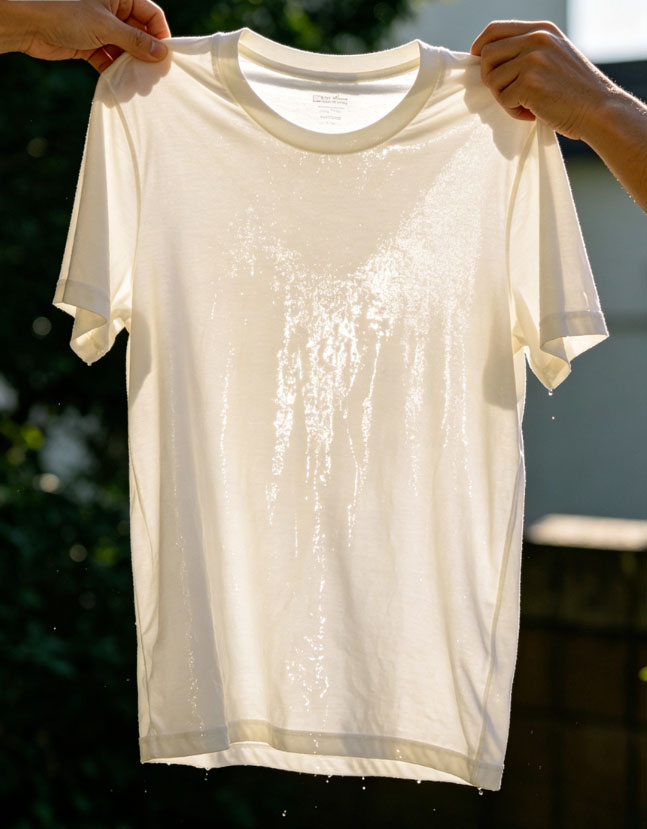
The shrinkage rate of general fabrics is:
| Fabric Type | Shrinkage Rate (%) |
|---|---|
| Cotton | 4 – 10 |
| Synthetic fibers | 4 – 8 |
| Cotton-polyester blend | 3.5 – 5.5 |
| Natural white cloth | 3 |
| Woolen blue cloth | 3 – 4 |
| Poplin | 3 – 4.5 |
| Printed fabrics | 3 – 3.5 |
| Twill fabric | 4 |
| Labor cloth (denim) | 10 |
| Artificial cotton (rayon) | 10 |
Factors affecting shrinkage rate
① Raw materials
Different raw materials result in different shrinkage rates for fabrics. Generally speaking, fibers with high hygroscopicity expand when soaked in water, increasing in diameter and shortening in length, thus resulting in a higher shrinkage rate. For example, some viscose fibers have a water absorption rate as high as 13%, while synthetic fiber fabrics have poor hygroscopicity and therefore a lower shrinkage rate.
② Density
Different fabric densities result in different shrinkage rates. If the warp and weft densities are similar, their warp and weft shrinkage rates will also be similar. Fabrics with higher warp density will have greater warp shrinkage, and conversely, fabrics with higher weft density will have greater weft shrinkage.
③ Yarn count
Fabrics with different yarn counts have different shrinkage rates. Fabrics with coarser yarns have a higher shrinkage rate, while fabrics with finer yarns have a lower shrinkage rate.
④ Production process
Different fabric production processes result in different shrinkage rates. Generally speaking, fabrics that are stretched multiple times during weaving and dyeing processes, have longer processing times, and are subjected to greater tension will have a higher shrinkage rate, and vice versa.
⑤ Fiber composition
Compared with synthetic fibers (such as polyester and acrylic), natural plant fibers (such as cotton and linen) and regenerated plant fibers (such as viscose) are more prone to moisture absorption and expansion, resulting in a larger shrinkage rate. Wool, on the other hand, is prone to felting due to the scaly structure on the fiber surface, which affects its dimensional stability.
⑥ Fabric structure
Generally, woven fabrics have better dimensional stability than knitted fabrics; high-density fabrics have better dimensional stability than low-density fabrics. Among woven fabrics, plain weave fabrics generally have a lower shrinkage rate than flannel fabrics; while among knitted fabrics, plain knit weaves have a lower shrinkage rate than rib knit weaves.
Production and processing: During dyeing, printing, and finishing, fabrics are inevitably stretched by the machines, resulting in tension within the fabric. However, this tension is easily released when the fabric comes into contact with water, leading to shrinkage after washing. In practice, pre-shrinking is generally used to address this issue.
⑦ Washing and Care Process
Washing and care includes washing, drying, and ironing, and each of these three steps affects the shrinkage of the fabric. For example, hand-washed samples have better dimensional stability than machine-washed samples, and the washing temperature also affects dimensional stability. Generally speaking, the higher the temperature, the worse the stability.
The drying method has a significant impact on the shrinkage rate of the fabric. Commonly used drying methods include drip drying, flat laying with metal mesh, hanging drying, and rotary drying. Among these, drip drying has the least impact on the fabric dimensions, while rotary drying has the greatest impact, with the other two methods falling in between.
In addition, choosing an appropriate ironing temperature based on the fabric’s composition can also improve shrinkage. For example, cotton and linen fabrics can have their dimensional shrinkage reduced by ironing at high temperatures. However, higher temperatures are not always better. For synthetic fibers, high-temperature ironing not only fails to improve shrinkage but can also damage their properties, such as making the fabric stiff and brittle.

I have over 25 years of experience in hat and apparel manufacturing. With a steady and detail-oriented approach, I oversee factory production and team operations, ensuring reliable quality and on-time delivery for customers worldwide