Introduction
When doing custom hats, the most common question customers ask me is:
“Why does the same hat cost more from you than from others?”
I really understand this question.
Because when customers receive a quote, they usually see only one number.
For example:
Factory A: $4.57
Factory B: $5.43
Factory C: $6.43
So it is easy to conclude:
The same hat, why is there such a big difference?
But after working in a hat factory for over 20 years, I want to tell you one thing:
The real comparison for hat quotes is never just the final number.
Today, I will start from when a customer sends an inquiry and break down all the costs of a hat from inquiry to shipment. Quoting rules, factory markups, and money‑saving opportunities – I will explain them all at once.
How Can a Hat Factory Quote Reasonably?
When a customer says “How much for 1000 pieces?”, it is really hard for the factory to quote.
“How much for 1000 baseball caps?”
From the customer’s perspective, that is normal.
But from the factory’s perspective, that information is far from enough.
Because “baseball cap” is only a style.
The factors that really affect the quote include at least:
Hat structure, fabric, weight, logo technique, accessories, washing process, packaging, quantity, delivery time, and quality control requirements.
For a simple example:
Even for the same pure cotton baseball cap,
280g ordinary cotton and 280g combed cotton perform differently;
ordinary curved brim and special short brim have different production difficulties;
ordinary flat embroidery and high-stitch 3D embroidery require different processing times;
500 pieces and 5000 pieces have different production efficiencies.
So when our factory receives an inquiry, we first determine what kind of hat it really is, and only then do we proceed to the quote.
What do you need to provide for a hat factory quote?
Having been making hats for over 20 years. Every day, I get inquiries from customers. They send me a picture and then wait for a quote.
To make the quote faster and more accurate, we usually confirm the following details:
① Hat style
Baseball caps, 5-panel caps, bucket hats, visors – they may all look like hats, but the production process and materials are completely different. Only when we know the style can we calculate the steps and materials needed.
② Quantity
500 pieces vs. 5000 pieces – material costs, production efficiency, and waste sharing are all different. The clearer your quantity, the closer the quote will be to the actual production cost.
③ Fabric requirements
Cotton, polyester, nylon, corduroy, canvas, functional fabrics – each has a different price.
If you already have a specific fabric in mind, tell us directly.
If not, we can suggest options based on your budget.
④ Process / decoration requirements
Embroidery, printing, leather patches, PVC patches, woven labels, washing effects, etc.
Each extra step adds to the processing cost.
A clear reference picture (front and back) is often more helpful than just a text description.
⑤ Size and target users
Adult sizes, kids’ sizes, Asian fit, European/American fit – head circumference affects the pattern and fabric usage.
For export orders, knowing the target market is especially important.
⑥ Packaging requirements
Plain OPP bags, individual color boxes, hang tags, barcode stickers, carton specifications – different packaging means different costs.
Many customers add packaging requirements later, which means we have to re-adjust the quote.
⑦ Target market
For exports to Japan, the US, or Europe, quality standards and testing requirements are different.
If we know where the hats will be sold, we can better recommend materials and processes.
A quote is not just a price – it is a production plan.
The more complete your information, the more accurate your quote.
The clearer the plan, the fewer changes later.
We always hope that our first quote is as close as possible to the final price, so we don’t have to keep adjusting it.
So, an accurate quote is never just about how fast the factory calculates – it’s about how thoroughly both sides communicate.
Hat Quote: 7 Key Parts
When I make a quote, I focus on these 7 cost modules:
- Fabric
- Accessories
- Workmanship
- Labor
- Wastage
- Quality control
- Management & production risks
Customers see the first two most easily, but the factory really calculates all of the latter.
First: Fabric cost
Fabric is the most visible cost, but there is a common pitfall here:
A lower unit price for fabric does not necessarily mean a lower finished product cost.
Why?
Because the factory also needs to consider actual fabric usage, cutting waste, layout utilization, stability after washing, and color batch consistency.
I once encountered a similar situation.
A customer brought a hat style that required a washed effect.
At first, the customer specified a cheaper cotton material.
After we tested it, we found that the size changed significantly after washing.
Later we adjusted the fabric – the unit price went up, but the stability of the finished product improved significantly.
In such cases, I usually suggest that customers first consider the product positioning before choosing the fabric.
Mid‑to‑high‑end hats need a stable fabric base.
For e‑commerce test orders, you can adjust cost through fabric specifications.
The key is matching.
Second: Accessories cost
A hat has more accessories than you might imagine:
Brim, buckle, sweatband, adjustment strap, fusible interlining, woven label, leather label, metal fittings, packaging materials.
Each individual item may seem to differ by only a few cents,
but when stacked together, the cost difference becomes obvious.
For example:
Ordinary buckle vs. custom metal buckle,
ordinary woven label vs. special‑process label,
basic packaging vs. custom packaging.
Customers often ask me: how much can a buckle differ?
Looking at just one item, the difference is limited,
but hat quotes are always the sum of multiple cost nodes.
So accessories are a good area for cost optimization,
provided you do not touch the core accessories that affect the hat shape and wearing experience.
Why can a logo add several dollars to the quote?
“I just add a logo – why does the price go up?”
Because logo workmanship is not just about “whether it is embroidered”.
Even for embroidery, you have to consider:
Logo area, stitch count, number of colors, thread material, embroidery position, backing, machine compatibility, and 3D effect.
Let me give you a real example.
A customer sent a gold embroidered logo – it looked great visually, but our partner factory reported that this type of gold thread was not ideal with their current machines.
So we had to re‑evaluate the thread, machine, and embroidery effect.
If we quoted directly from the picture, we would likely face process discrepancies later.
So when we quote hats, we always break down the logo separately.
The more complex the process, the longer the machine occupation, the more manual adjustments – the higher the cost.
The same applies to washing.
Regular wash, enzyme wash, stone wash, local fading, wax brushing – the pricing logic is completely different, especially for washed hats.
The actual cost the factory bears also includes pre‑production testing and effect control.
Why are small batch custom orders generally quoted higher?
Today I will explain it from a cost perspective.
When a production line receives a new hat style, what does it need to do?
- Re‑examine the process
- rearrange production
- readjust equipment
- workers get familiar with the process
- re‑establish production rhythm
The cost difference between 500 pieces and 5000 pieces is very obvious.
For example, between 1000 hats and 10,000 hats,
the upfront preparation workload is limited in difference,
but fixed costs can be spread over more products,
so the unit price naturally drops.
That is also why the unit price usually decreases as quantity increases.
The core reason for higher quotes on small orders is usually production efficiency,
and that is separate from whether the factory is willing to take the order.
The most overlooked cost in quotes: wastage
Fabric cutting has waste.
Accessory production has waste.
Defective products also occur during production.
For example:
- fabric color difference
- embroidery misalignment
- stitching issues
- brim deformation
- abnormal washing effect
- size deviation
The factory needs to reserve a reasonable amount of production wastage in the quote.
Here I particularly want to remind customers:
Some quotes look very low – perhaps because they reserve less for wastage and production risks.
The initial quote looks attractive,
but later when production encounters problems, both sides will have repeated communications.
So I personally prefer to calculate the true production cost upfront.
A clear quote makes later cooperation much easier.
Why does quality control affect hat quotes too?
Many customers wonder: why do you include quality control in your quote?
Because hats really need to be inspected before shipment.
Size, hat shape, brim, stitching, logo, stains, color difference, appearance, etc.
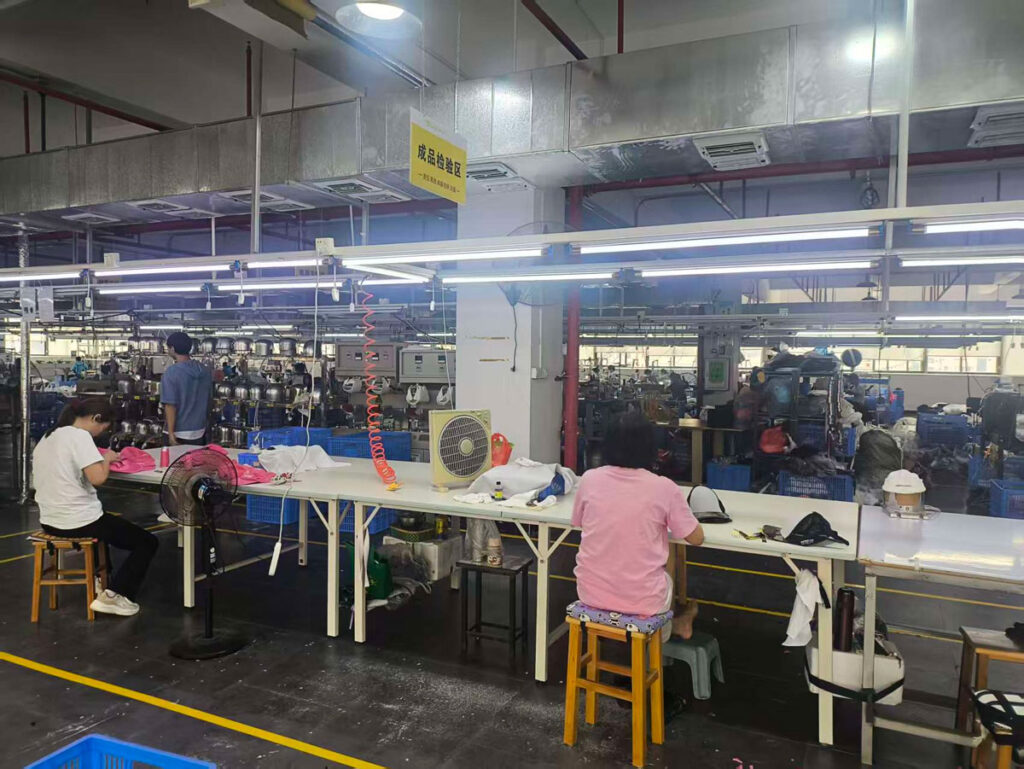
Our factory has dedicated quality inspectors.
After a batch is completed, it goes through screening.
Especially for export orders,
the customer’s top concern is:
can this batch be sold directly?
So the value of quality control often shows after shipment.
From a cost perspective:
Doing an extra round of inspection upfront,
versus reworking the entire batch later –
these two costs are completely different.
Why do factories add markups?
I think this question should be addressed directly.
Normal markups usually come from the following reasons:
- Increased product complexity – complex hat styles, complex processes, longer production time.
- Small quantity – fixed production costs cannot be fully spread.
- Tight delivery time – need to rearrange production schedules.
- Higher quality control requirements – export standards, brand standards may differ.
- Frequent custom modifications – each change may affect pattern making and production.
Here is my personal judgment standard:
A factory can add markup, but it should clearly explain the reasons.
When the customer asks: “Why is it more expensive?”
The factory should be able to answer:
It is more expensive in fabric.
It is more expensive in logo workmanship.
It is more expensive in washing.
It is more expensive in quantity and production efficiency.
A quote that can break down the costs makes it easier for the customer to judge whether it is worth it.
Why Hat Quotations Vary: 5 Hidden Reasons Behind Price Gaps
For the same hat, why can different factories differ by $1.43 or even more?
I have summarized 5 common situations.
First, different product understanding.
The customer says “pure cotton hat”.
One factory quotes based on ordinary pure cotton,
another quotes based on higher‑grade fabric –
costs naturally differ.
Second, different process standards.
One factory follows ordinary processes,
another follows higher standards –
quotes will differ.
Third, different wastage calculations.
Some factories quote aggressively,
others factor in production risks.
Fourth, different factory positioning.
High‑volume factories and small‑batch specialized factories have different cost structures.
Fifth, different scope of the quote.
This is particularly important.
Before quoting, you must ask clearly:
Is fabric included?
Is embroidery included?
Is washing included?
Is packaging included?
Is inspection included?
Is transportation included?
If the scope differs, simply comparing the final number has limited value.
Where to Cut Costs: 5 Practical Ways to Save Money on Custom Hats
Where customers can really save money – I suggest these 5 points.
① Match fabric specifications.
If the product positioning is a test order, do not start with excessively high‑grade fabric.
If it is a brand line, the fabric quality needs to be stable.
Matching is more important than blindly pursuing high specifications.
② Unify logo workmanship.
For the same hat, try to keep the logo process consistent.
Multiple processes stacked together increase production complexity.
③ Optimize packaging.
Often packaging is an area where costs can be reduced more easily,
especially for e‑commerce test orders.
④ Confirm processes in advance.
Frequent later modifications are a common cause of cost increases.
⑤ Increase order quantity.
With larger quantities, fixed costs are spread more fully.
This is also the most direct way to reduce unit cost.
3 Areas Where You Should Never Cut Corners
These 3 areas – I personally do not recommend customers cut costs.
To put it bluntly:
First, the hat structure.
Whether a hat looks good when worn – the structure is the core.
Second, the basic fabric quality.
Especially for washed hats – the base fabric quality directly affects the final effect.
Third, quality control.
If a batch has problems, rework, replenishment, and customer complaints – these costs are far higher than the few dollars saved upfront.
After all these years in the hat factory business,
I think the real difficulty in quoting is never about calculating the price.
It is about clearly explaining the cost logic of a hat.
The customer sees:
$4.57, $5.43, $6.43.
The factory sees:
fabric, accessories, workmanship, labor, wastage, quality control, delivery time, risks.
So next time you receive two hat quotes,
I suggest you do not rush to ask:
“Which one is cheaper?”
Instead ask:
“Are the product standards behind these two quotes the same?”
Price Ranges by Hat Style (Based on China Factory Quotes)
Estimates for 50–100 pieces per style. Actual prices depend on fabric, logo, and finishing.
Notes:
- Prices are for 50–100 pcs. Final cost depends on qty, fabric, and workmanship (e.g., stitch count).
- FOB: Prices are FOB factory port, excluding international freight and insurance.
Custom Hat FAQ

I’m Kailyn, the founder of Aung Crown. I’ve spent over a decade “in the trenches” of the hat and clothing trade, learning exactly what it takes to make a product stand out. I’m a bit of a perfectionist when it comes to design and quality, but that’s because I care about your brand’s success as much as you do. Whether you need production advice or post-sales support, I’ve got you covered every step of the way.